
What is SEO? SEO stands for Search Engine Optimization.
It is the process of improving a website and its content so that search engines can better understand it and people can discover it through relevant search results.
In simple terms:
SEO helps your website become easier to discover when people search for information, products, services, or answers related to what you offer.
For example, if someone searches for:
“what is keyword research?”
a website that has created a useful, well-structured page about keyword research may have an opportunity to appear in the search results.
SEO is not simply about adding keywords to a webpage.
Modern SEO involves understanding what people are searching for, creating genuinely useful content, building a logical website structure, improving technical performance, and making pages easy for both users and search engines to understand.

What Does SEO Stand For?
SEO stands for Search Engine Optimization.
Breaking the term down makes it easier to understand:
Search Engine
A system such as Google or Bing that helps people find information online.
Optimization
Improving something so that it works more effectively.
So, Search Engine Optimization means improving webpages and websites so they can be better understood by search engines and provide a useful experience for visitors.
SEO focuses on helping the right content reach the right audience through organic search.
How Does SEO Work?
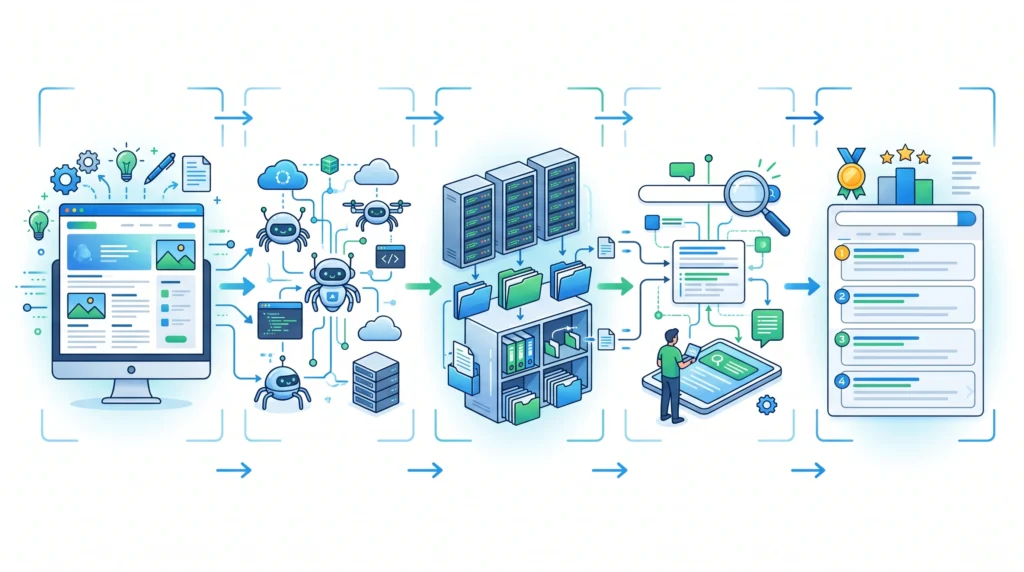
Search engines use automated systems to discover and organize webpages.
A simplified version of the process is:
Crawling → Indexing → Understanding → Ranking → Search Results
Crawling
Search engines use automated programs to discover webpages and follow links to find additional content.
Indexing
After discovering a page, a search engine may analyze and store information about that page in its index.
Understanding Content
Search engines try to understand what a webpage is about and how relevant it may be to different searches.
Ranking
When someone performs a search, search engines determine which results are most useful and relevant for that particular query.
The exact systems used by search engines are complex and continuously evolving.
Why Is SEO Important?
SEO can help businesses, publishers, creators, and organizations make their content more discoverable through organic search.
A successful SEO strategy can help you:
- Increase organic visibility
- Attract relevant visitors
- Reach people actively searching for your topic
- Build long-term website traffic
- Improve content discoverability
- Support brand awareness
- Create useful content for your audience
Unlike paid advertising, organic search traffic doesn’t require paying for every individual click.
However, SEO still requires investment in content, technical improvements, research, and ongoing optimization.
What Is Organic Traffic?
Organic traffic refers to visitors who reach your website through unpaid search engine results.
For example:
Someone searches:
“best SEO tools for beginners”
They click a non-ad search result and visit your website.
That visit is considered organic search traffic.
Organic traffic can become valuable because it often comes from people who are actively looking for a particular topic, product, service, or solution.
SEO vs Paid Search
SEO and paid search can both help a website appear in search results, but they work differently.
| SEO | Paid Search |
|---|---|
| Focuses on organic results | Focuses on paid advertisements |
| Usually takes time to build | Can generate visibility quickly |
| Requires ongoing optimization | Requires advertising budget |
| Can support long-term traffic | Traffic generally depends on active campaigns |
| Focuses on organic visibility | Focuses on paid placement |
Many businesses use both strategies depending on their goals.
The Main Types of SEO
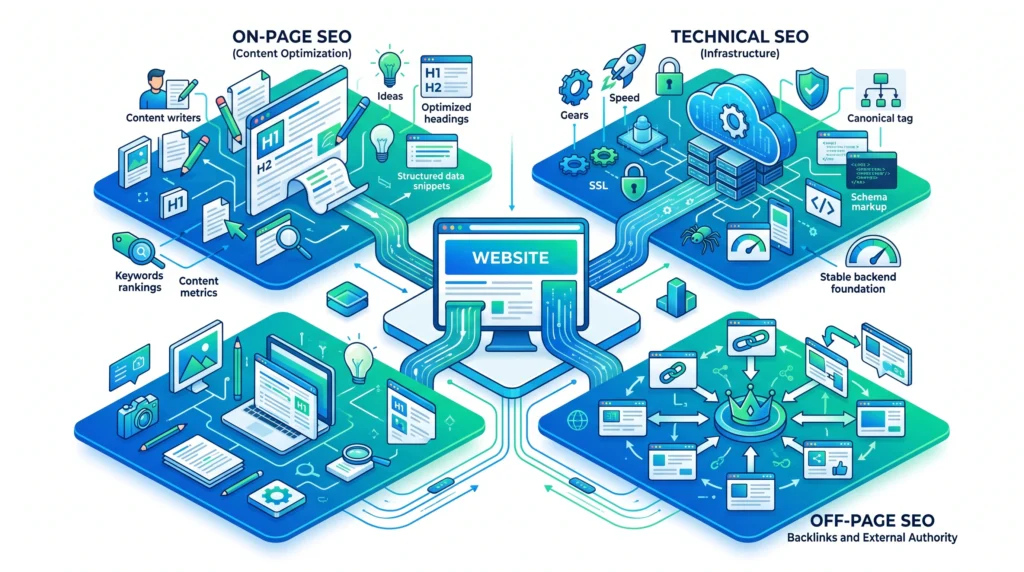
SEO can be divided into several major areas.
On-Page SEO
On-page SEO focuses on elements within your webpages.
Examples include:
- Content
- Keywords
- SEO titles
- Meta descriptions
- Headings
- Images
- URLs
- Internal links
- Search intent
Technical SEO
Technical SEO focuses on the technical foundation of your website.
It can include:
- Crawling
- Indexing
- Website architecture
- Mobile usability
- Page performance
- Structured data
- XML sitemaps
Off-Page SEO
Off-page SEO focuses on signals and activities outside your own website.
Examples can include:
- Relevant backlinks
- Digital PR
- Brand mentions
- Online authority
These areas work together rather than functioning as completely separate strategies.
What Is Keyword Research?
Keyword research is the process of discovering and evaluating the words and phrases people use when searching online.
For example, if your website is about SEO, possible topics might include:
- SEO basics
- keyword research
- on-page SEO
- technical SEO
- SEO tools
- search intent
Keyword research helps you understand what your audience wants to find.
But effective SEO isn’t about choosing keywords and repeating them repeatedly.
It is about understanding the topic, search intent, audience, and information needed to satisfy the search.
What Is Search Intent?
Search intent is the reason behind a search query.
For example:
“What is SEO?”
This suggests informational intent.
The person wants to understand SEO.
But:
“Best SEO tools”
may indicate that the person is researching available tools.
And:
“Buy SEO software”
shows a much stronger commercial or transactional intent.
Understanding search intent helps you create content that matches what the searcher actually wants.
What Is On-Page SEO?
On-page SEO is the process of optimizing elements within a webpage.
This includes:
- Helpful content
- SEO titles
- Meta descriptions
- Headings
- Images
- URLs
- Internal links
- Natural keyword usage
The goal is to make the page clear, useful, relevant, and easy to navigate.
For more detail, see:
Article 9 — What Is On-Page SEO?
What Is Technical SEO?
Technical SEO focuses on making the technical foundation of a website easier for search engines to crawl, understand, and access.
It can involve areas such as:
- Site architecture
- Crawling
- Indexing
- Mobile usability
- Page performance
- Structured data
- XML sitemaps
Technical SEO is especially important as websites become larger and more complex.
What Is Off-Page SEO?
Off-page SEO refers to activities and signals that occur outside your website.
One of the best-known examples is earning relevant backlinks from other websites.
Other activities can include:
- Digital PR
- Brand mentions
- Content promotion
- Relationship building
The focus should be on building genuine authority and visibility rather than manipulating links.
How Long Does SEO Take to Work?
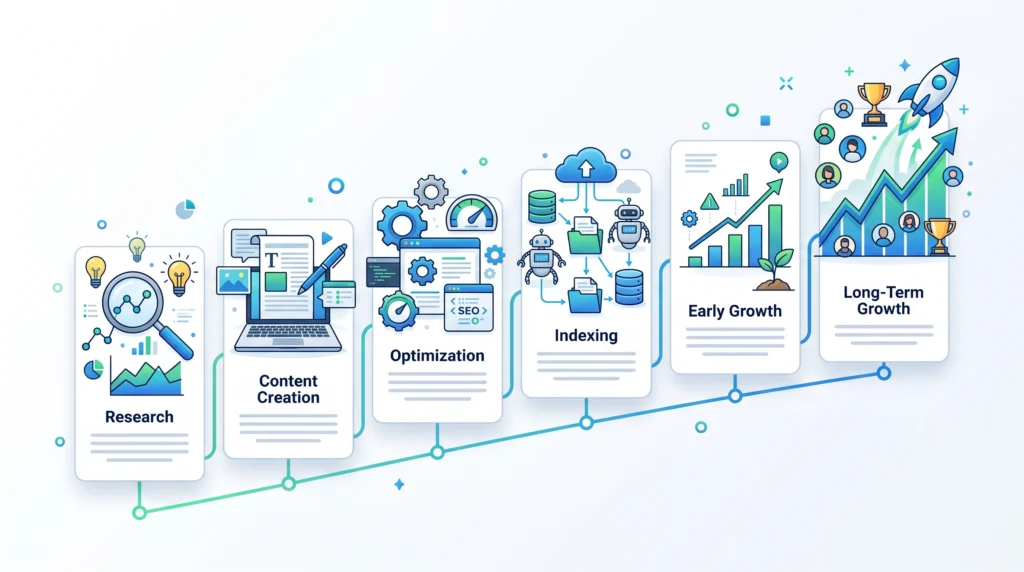
SEO usually takes time.
There is no universal timeline because results depend on factors such as:
- Website age
- Competition
- Content quality
- Search demand
- Website authority
- Technical condition
- Search intent
- Existing backlinks
- Consistency of publishing and optimization
Some changes may become visible relatively quickly, while competitive topics can take considerably longer.
SEO should generally be treated as a long-term growth strategy, not an overnight solution.
For a deeper explanation, see:
Article 4 — How Long Does SEO Take to Work?
What Are the Most Important SEO Factors?
There isn’t one single ranking factor that guarantees success.
A strong SEO strategy usually considers:
Helpful Content
Create content that genuinely satisfies the user’s needs.
Relevance
Make sure your page is closely related to the search query.
Search Intent
Understand what the searcher is trying to accomplish.
Technical Accessibility
Make sure search engines can access and understand your important pages.
Website Structure
Connect related pages logically through navigation and internal linking.
Authority and Links
Build genuine authority and earn relevant references from other websites.
User Experience
Make content easy to read, navigate, and use.
Common SEO Mistakes Beginners Should Avoid
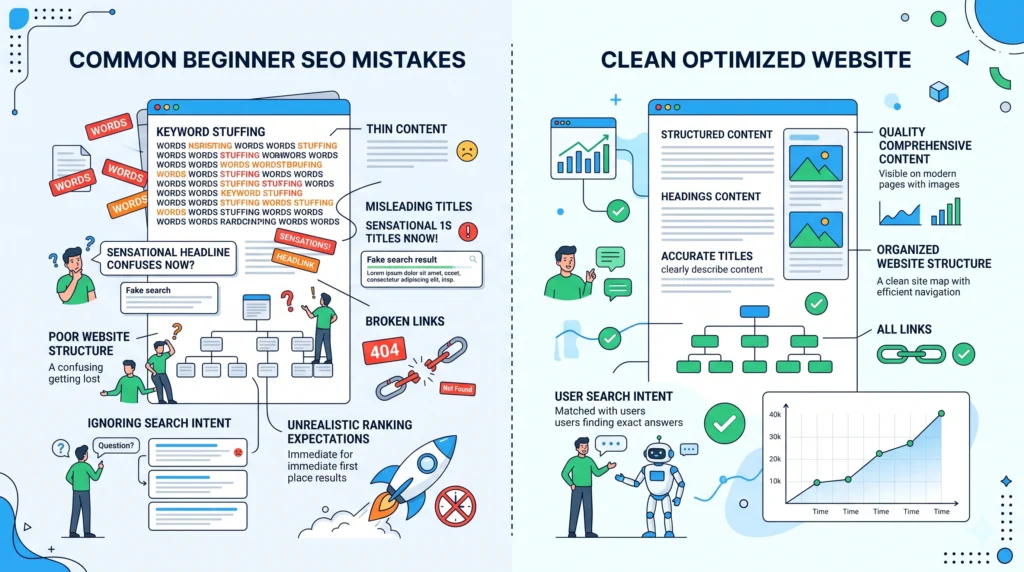
Keyword Stuffing
Repeating keywords excessively can make content unnatural and difficult to read.
Creating Content Only for Search Engines
Content should be created to help people, not simply to insert keywords.
Ignoring Search Intent
A page can target a keyword and still fail if it doesn’t answer what the searcher actually wants.
Publishing Thin Content
Don’t create pages that provide little meaningful value just to target additional keywords.
Expecting Instant Results
SEO takes time and results vary significantly between websites and topics.
Buying Low-Quality Links
Artificial or manipulative link-building practices can create SEO risks.
Ignoring Technical Problems
Great content may struggle if important pages cannot be properly crawled, indexed, or accessed.
How to Start SEO as a Beginner
If you’re completely new to SEO, don’t try to optimize everything at once.
Follow a simple process:
Step 1 — Learn SEO Basics
Understand crawling, indexing, rankings, keywords, search intent, and organic traffic.
Step 2 — Research Your Audience
Find out what your audience searches for and what questions they need answered.
Step 3 — Perform Keyword Research
Identify relevant topics and search terms.
Step 4 — Understand Search Intent
Determine what type of content searchers expect.
Step 5 — Create Helpful Content
Answer the searcher’s question clearly and thoroughly.
Step 6 — Optimize the Page
Improve titles, headings, URLs, images, internal links, and content structure.
Step 7 — Improve Technical SEO
Make sure important pages are accessible and technically sound.
Step 8 — Build Authority
Promote useful content and earn relevant references and links.
Step 9 — Monitor Performance
Track organic visibility, traffic, rankings, and conversions where appropriate.
Step 10 — Keep Improving
SEO is an ongoing process.
SEO Checklist for Beginners
Before publishing an important page, check:
- Clear search intent
- Relevant primary keyword
- Helpful original content
- Clear SEO title
- Useful meta description
- One clear H1
- Logical H2 and H3 structure
- Descriptive URL
- Relevant internal links
- Optimized images
- Useful alt text where appropriate
- Mobile-friendly experience
- Important page can be crawled and indexed
- No keyword stuffing
- No misleading claims
- Content provides genuine value
How Can You Track SEO Progress?
You can use Google Search Console to monitor how your website performs in Google Search, including clicks, impressions, and search queries.
For additional guidance on how Google Search works and how website owners can improve their visibility, explore Google Search Central.
Frequently Asked Questions
What Is SEO in Simple Words?
SEO is the process of improving a website and its content so that search engines can better understand it and people can discover it through relevant organic search results.
What Does SEO Stand For?
SEO stands for Search Engine Optimization.
Why Is SEO Important?
SEO can help websites improve organic visibility, attract relevant visitors, and build sustainable search traffic over time.
Is SEO Free?
Organic search results don’t require paying a search engine for every click, but SEO is not necessarily free. It can require time, expertise, content creation, tools, technical work, and other resources.
How Long Does SEO Take?
There is no universal timeline. Results depend on factors such as competition, website authority, content quality, technical condition, search demand, and the work being done.
Can Beginners Learn SEO?
Yes. Beginners can learn SEO by starting with fundamentals such as search intent, keyword research, on-page SEO, technical SEO, internal linking, and content quality.
Does SEO Guarantee Google Rankings?
No. No legitimate SEO strategy can guarantee a specific ranking position.
What Is the Difference Between SEO and SEM?
SEO generally refers to improving organic search visibility, while SEM is a broader term that can include search engine marketing through paid search and other search-related activities.
Final Thoughts
SEO is not simply about ranking #1 on Google.
At its core, SEO is about helping people find useful information when they search online.
A strong SEO strategy combines:
Helpful Content
Keyword Research
Search Intent
On-Page SEO
Technical SEO
Internal Linking
Relevant Authority
When these elements work together, your website has a stronger foundation for long-term organic growth.
If you’re a beginner, start small.
Learn the fundamentals, understand your audience, create genuinely useful content, and improve your website step by step.
SEO is a long-term process—but when done thoughtfully, it can become one of the most valuable sources of sustainable website visibility and organic traffic.
Related Articles
Article 2:
How Do Search Engines Work?how-do-search-engines-work
Article 3:
Why Is SEO Important?why-is-seo-important
Article 4:
How Long Does SEO Take to Work?how-long-does-seo-take-to-work
Pillar 2 — Keyword Research:keyword-research
Pillar 3 — On-Page SEO:on-page-seo
Internal Linking Suggestions
Naturally link this article to:
- How Do Search Engines Work?
- Why Is SEO Important?
- How Long Does SEO Take to Work?
- What Is Keyword Research?
- What Is Search Intent?
- What Is On-Page SEO?
- SEO Headings
- Internal Linking
Recommended anchor text:
- how search engines work
- why SEO is important
- SEO timeline
- keyword research
- search intent
- on-page SEO
- SEO headings
- internal linking
Also link this article back to the main Pillar 1 — SEO Basics page.
Publishing Checklist
- H1 clearly labelled
- H2 headings clearly labelled
- H3 headings clearly labelled
- SEO title prepared
- Meta title prepared
- Meta description prepared
- URL slug prepared
- Focus keyword included naturally
- Secondary keywords used naturally
- Positive words included naturally
- Caution words included naturally
- SEO definition included
- SEO process explained
- Organic traffic explained
- SEO vs paid search explained
- Main SEO types explained
- Keyword research explained
- Search intent explained
- On-page SEO explained
- Technical SEO explained
- Off-page SEO explained
- SEO timeline explained
- Beginner mistakes included
- Beginner roadmap included
- SEO checklist included
- FAQs included
- Image placements marked
- Image prompts included
- Image filenames included
- Alt text included
- Internal linking suggestions included
- No keyword stuffing
- No guaranteed ranking claims
- Beginner-friendly language used
- Content is easy to scan
- Content provides genuine value
