
SEO titles and meta descriptions are important parts of on-page SEO.
They help communicate what a webpage is about and can influence how your page appears in search results.
A well-written title tells searchers what they can expect from the page, while a useful meta description provides additional context.
The goal is simple:
Make the search result clear, relevant, and useful.

What Is an SEO Title?
An SEO title is the title associated with a webpage and is commonly represented by the HTML <title> element.
It helps communicate the topic of a page to search engines and users.
For example:
SEO Title:
How to Optimize SEO Titles and Meta Descriptions
A strong title should clearly communicate what the page is about.
It should be:
- Relevant
- Clear
- Specific
- Concise
- Useful to the intended audience
What Is a Meta Description?
A meta description is an HTML attribute that provides a brief summary of a webpage.
Search engines may use it as part of the search result snippet, although they can also generate a different snippet based on the search query and page content.
A useful meta description explains what the page offers.
For example:
Meta Description:
Learn how to write SEO titles and meta descriptions that clearly describe your content, match search intent, and attract the right visitors.
The description should accurately represent the page rather than promise something the content doesn’t provide.

SEO Title vs Meta Description
SEO titles and meta descriptions have different roles.
| Element | Main Purpose |
|---|---|
| SEO Title | Communicates the primary topic of the page |
| Meta Description | Summarizes what the page offers |
| SEO Title | Usually appears prominently in search results |
| Meta Description | May appear as supporting search-result text |
Think of the title as the headline and the meta description as the short explanation underneath it.
Both should accurately represent the page.
Why Are SEO Titles Important?

SEO titles are important because they help users and search engines understand the topic of a page.
A clear title can help:
- Communicate the page topic
- Set accurate expectations
- Align with search intent
- Make search results easier to understand
- Differentiate your page from competing results
A title should not be written only to attract clicks.
It should attract the right clicks by accurately describing the content.
Why Are Meta Descriptions Important?
Meta descriptions provide additional context about a page.
A useful description can help searchers understand:
- What the page covers
- What they can learn
- Whether the page is relevant to their query
However, remember that search engines may choose to display a different snippet instead of the exact meta description you provide.
So your page content should also clearly communicate its topic.
How to Write a Good SEO Title
A strong SEO title should communicate the page topic quickly.
Keep the Main Topic Clear
Make sure the title tells users exactly what they will find.
Weak:
SEO Tips
Better:
SEO Tips for Beginners: 10 Practical Ways to Improve Rankings
The second title gives the reader much more information.
Match Search Intent
If someone searches:
“How to do keyword research”
a suitable title might be:
How to Do Keyword Research Step by Step
The title directly matches the user’s goal.
Use the Primary Keyword Naturally
If the primary keyword is relevant, include it naturally.
For example:
Primary Keyword:
SEO Headings
Title:
SEO Headings: H1, H2 and H3 Explained
There is no need to repeat the keyword multiple times.
Make Every Word Useful
Avoid unnecessary words that don’t add meaning.
A concise title is easier to understand.
How to Write a Good Meta Description
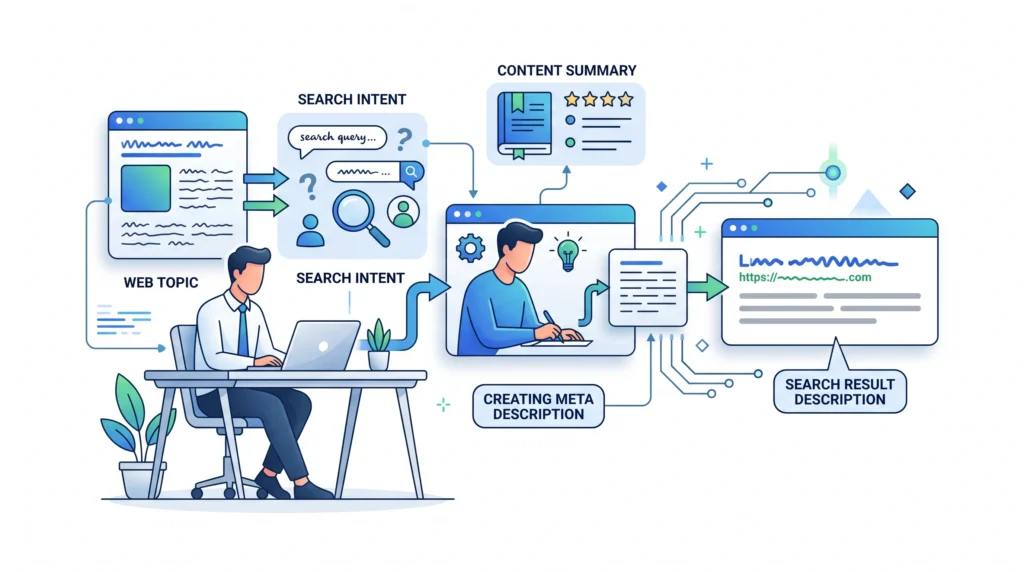
A good meta description should:
- Clearly summarize the page
- Match search intent
- Explain the page’s value
- Use natural language
- Accurately represent the content
For example:
Weak:
SEO is important. Learn SEO and SEO tips for SEO.
Better:
Learn the fundamentals of SEO, including keyword research, on-page optimization, technical SEO, and practical ways to improve search visibility.
The second version gives the reader useful information instead of repeating keywords.
Should You Include Keywords in SEO Titles?
Yes, when relevant.
Including the primary keyword or a close variation can make the topic clear.
For example:
Keyword:
On-Page SEO
Title:
What Is On-Page SEO? Complete Beginner’s Guide
But don’t force keywords into titles when they make the title unnatural.
The priority should be:
Relevance → Clarity → User Value → Natural Keyword Use
Should You Include Keywords in Meta Descriptions?
You can naturally include relevant keywords in a meta description.
Search engines may highlight words that match a user’s query in the displayed snippet.
However, don’t write meta descriptions simply to repeat keywords.
Focus on accurately explaining what the page offers.
What Is the Ideal Length for an SEO Title?
There is no universal character limit that guarantees a perfect title.
Search engines can truncate titles depending on available display space, device, and other factors.
Instead of obsessing over an exact character count, focus on:
- Putting the main topic early
- Keeping the title concise
- Removing unnecessary words
- Making the title descriptive
- Avoiding repetition
Always preview how your title looks in your SEO tool or CMS when possible.
What Is the Ideal Length for a Meta Description?
There is also no permanent universal character limit for meta descriptions.
Search result snippets can vary depending on the query, device, and search engine.
Instead of targeting an arbitrary number, make the description:
- Concise
- Relevant
- Useful
- Accurate
- Focused on the page’s value
How to Optimize Titles for Search Intent
Search intent should guide your title.
For example:
Informational Intent
Search:
What is technical SEO?
Suitable title:
What Is Technical SEO? Beginner’s Guide
How-To Intent
Search:
How to optimize images for SEO
Suitable title:
How to Optimize Images for SEO: Step-by-Step Guide
Commercial Investigation
Search:
Best SEO tools for beginners
Suitable title:
Best SEO Tools for Beginners: Features and Comparison
The title should reflect what the searcher is actually trying to accomplish.
Common SEO Title Mistakes
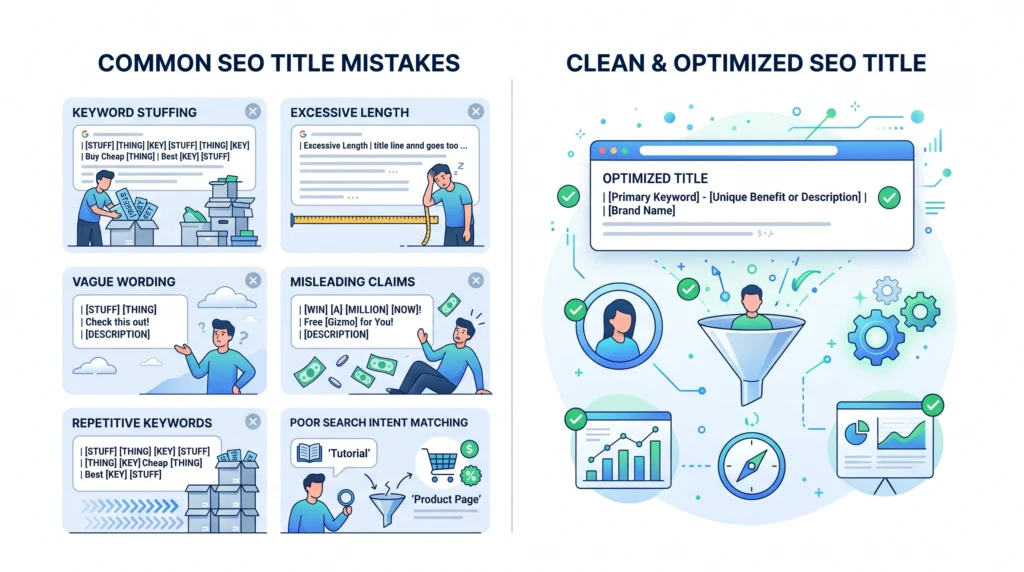
Keyword Stuffing
Don’t repeat the same keyword unnecessarily.
Misleading Titles
Never promise information that the page doesn’t provide.
Vague Titles
Titles such as “SEO Tips” don’t always communicate enough context.
Excessive Clickbait
Avoid exaggerated claims designed only to generate clicks.
Ignoring Search Intent
A title should reflect what the searcher expects to find.
Duplicate Titles
Important pages should generally have descriptive titles that distinguish them from one another.
Common Meta Description Mistakes
Avoid:
- Keyword stuffing
- Generic descriptions
- Misleading claims
- Duplicate descriptions across important pages
- Descriptions unrelated to page content
- Excessive promotional language
- Writing descriptions that don’t explain the page’s value
Your meta description should work as a concise preview of the content.
SEO Title and Meta Description Examples
Example 1 — Beginner SEO Guide
SEO Title:
What Is SEO? The Ultimate Beginner’s Guide
Meta Description:
Learn what SEO is, how search engines work, and how beginners can improve website visibility and organic traffic.
Example 2 — Keyword Research
SEO Title:
How to Do Keyword Research Step by Step
Meta Description:
Learn how to find, evaluate, and organize relevant keywords based on search intent, competition, and your content goals.
Example 3 — On-Page SEO
SEO Title:
What Is On-Page SEO? Complete Beginner’s Guide
Meta Description:
Learn how to optimize webpage content, titles, headings, images, URLs, and internal links for better on-page SEO.
SEO Titles and Meta Descriptions Checklist
Before publishing a page, check:
SEO Title
- Clearly describes the page
- Matches search intent
- Primary keyword is used naturally when relevant
- Main topic appears early when practical
- No keyword stuffing
- No misleading claims
- Title is unique and descriptive
Meta Description
- Accurately summarizes the page
- Matches search intent
- Provides useful context
- Uses natural language
- Includes relevant terms naturally
- Doesn’t repeat keywords excessively
- Doesn’t promise information the page doesn’t contain
Frequently Asked Questions
What Is an SEO Title?
An SEO title is the title associated with a webpage, commonly defined through the HTML title element. It helps communicate the page topic to users and search engines.
What Is a Meta Description?
A meta description is an HTML attribute that provides a short summary of a webpage. Search engines may use it in the search result snippet.
How Long Should an SEO Title Be?
There is no fixed character limit that guarantees the title will display perfectly. Focus on keeping it concise, descriptive, and relevant.
How Long Should a Meta Description Be?
There is no permanent ideal character count. Write a concise and useful description that accurately summarizes the page.
Should Every Page Have a Unique SEO Title?
Important pages should generally have unique, descriptive titles so users and search engines can distinguish their topics.
Do Meta Descriptions Directly Improve Rankings?
Meta descriptions are not generally treated as a direct ranking factor. Their main value is helping communicate what a page is about and potentially improving how useful and appealing the search result appears.
Can Google Rewrite My Meta Description?
Yes. Search engines may generate a different search-result snippet based on the user’s query and the content of the page.
Should I Put My Focus Keyword in the Title?
When the keyword accurately represents the page topic, using it naturally in the title can be helpful. Don’t force it if it makes the title awkward.
Final Thoughts
SEO titles and meta descriptions are small pieces of a webpage, but they play an important role in communicating your content to searchers.
The best approach is simple:
Be Clear.
Be Relevant.
Match Search Intent.
Describe the Real Value of the Page.
Use Keywords Naturally.
Don’t try to manipulate search results with keyword stuffing or misleading clickbait.
Instead, create titles and descriptions that accurately tell the right audience what your page offers.
That approach creates a stronger foundation for effective on-page SEO and a better experience for people searching for your content.
Related Articles
Article 9:
What Is On-Page SEO?what-is-on-page-seo
Article 11:
SEO Headings: H1, H2 and H3 Explainedseo-headings
Article 12:
Internal Linking: Complete SEO Guideinternal-linking
Pillar 2 — Keyword Research:
Keyword Research
Internal Linking Suggestions
Use natural anchor text such as:
- on-page SEO
- SEO headings
- keyword research
- search intent
- internal linking
- long-tail keywords
Link this article back to the Pillar 3 — On-Page SEO page and connect it naturally with Articles 9, 11, and 12.
Publishing Checklist
- H1 clearly labelled
- H2 headings clearly labelled
- H3 headings clearly labelled
- SEO title prepared
- Meta title prepared
- Meta description prepared
- URL slug prepared
- Focus keyword included naturally
- Secondary keywords used naturally
- Positive words included naturally
- Caution words included naturally
- SEO title explained
- Meta description explained
- Title vs description comparison included
- Search intent explained
- Keyword usage explained
- Length considerations explained
- Examples included
- Common mistakes included
- Checklist included
- FAQs included
- Image placements marked
- Image prompts included
- Image filenames included
- Alt text included
- Internal linking suggestions included
- No keyword stuffing
- No guaranteed ranking claims
- Beginner-friendly language used
- Content is easy to scan
