


What Is Keyword Research?
Keyword research is the process of finding and analyzing the words and phrases people use when searching for information, products, services, or solutions online.
It helps you understand what your audience is looking for and gives you ideas for creating content that matches those searches.
For example, if your website is about SEO, potential keyword ideas could include:
- What is SEO?
- How does SEO work?
- How to do keyword research
- What is search intent?
- Best SEO tools for beginners
Keyword research helps transform a broad topic into a structured content strategy.
The basic process is:
Find → Analyze → Group → Prioritize → Create → Optimize → Measure
Why Is Keyword Research Important?
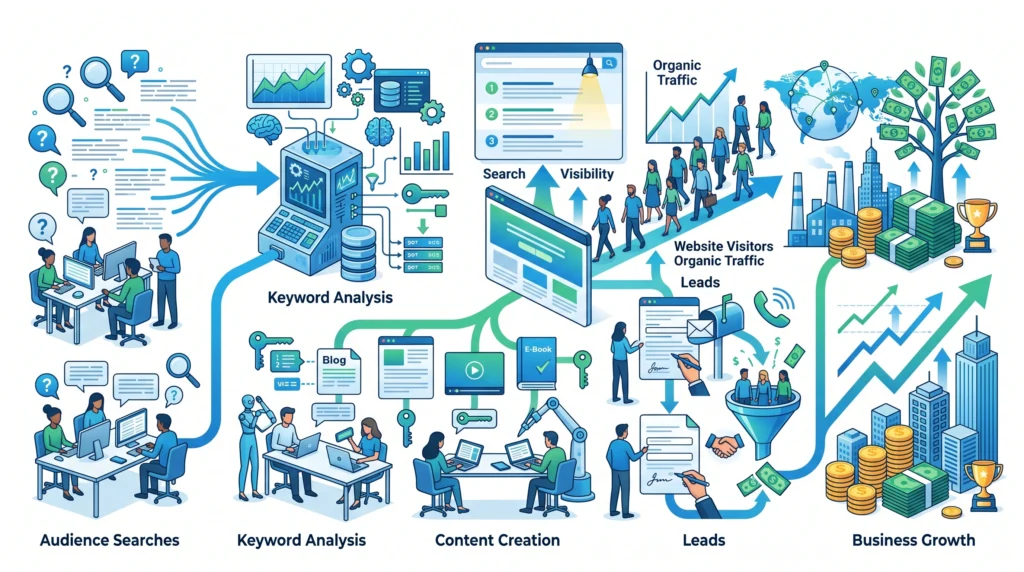
Without keyword research, you may create content based on assumptions.
You might choose a topic because you think people are interested in it, only to discover that:
- Search demand is limited
- Competition is very high
- The keyword has the wrong intent
- The topic isn’t relevant to your audience
- The searchers aren’t likely to become useful visitors
Keyword research helps you make more informed content decisions.
It can help you:
- Discover content opportunities
- Understand your audience
- Find relevant topics
- Identify long-tail keywords
- Understand search intent
- Evaluate competition
- Plan content clusters
- Improve organic visibility
Step 1: Choose a Broad Topic
Start with a broad topic that is directly related to your website, business, product, service, or expertise.
For example, if your website is about SEO, your broad topics could include:
- SEO
- Keyword research
- On-page SEO
- Technical SEO
- Link building
- Local SEO
- Content SEO
Don’t worry about finding the perfect keyword at this stage.
Your goal is simply to identify a useful topic area.
Example
Suppose your broad topic is:
Keyword Research
You can now expand this topic into more specific searches.
Step 2: Brainstorm Initial Keyword Ideas
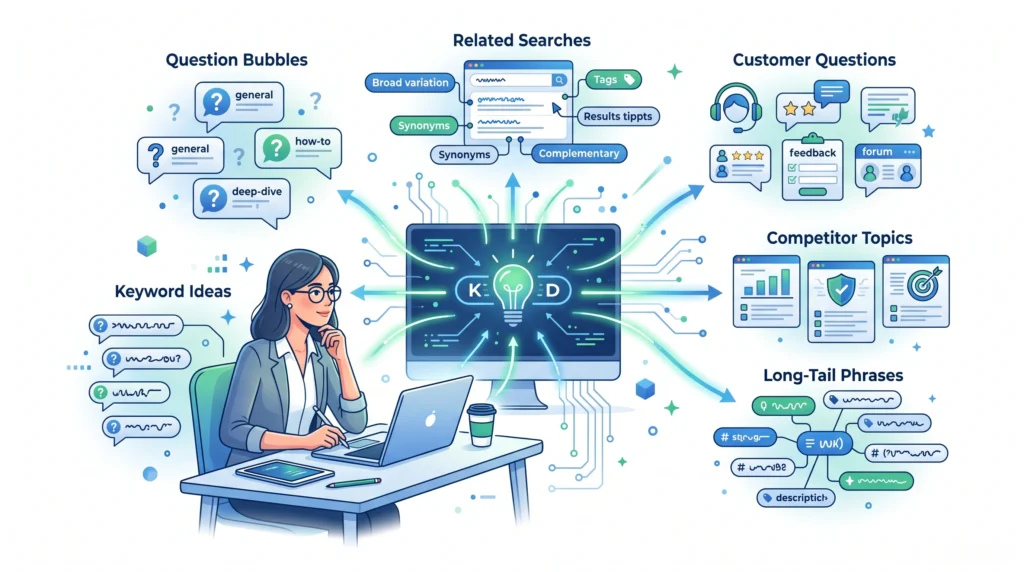
Create a list of possible searches related to your topic.
For keyword research, you might brainstorm:
- What is keyword research?
- How to do keyword research
- Keyword research tools
- Keyword difficulty
- Search intent
- Long-tail keywords
- Keyword search volume
- SEO keywords
At this stage, quantity is more important than perfection.
You can analyze and filter the ideas later.
Step 3: Use Search Suggestions
Search engines can provide useful keyword ideas through autocomplete and related searches.
Start typing your topic and look at the suggestions that appear.
For example, a search beginning with:
“keyword research…”
may lead you toward more specific questions and phrases.
You can also examine related searches displayed around the search results.
These suggestions can reveal how people naturally phrase their searches.
Step 4: Find Questions People Ask
Questions can be excellent keyword opportunities.
Look for questions related to your topic such as:
- What is keyword research?
- Why is keyword research important?
- How does keyword research work?
- How do I find keywords?
- What is keyword difficulty?
- What are long-tail keywords?
These questions can become:
- Blog posts
- FAQ sections
- Guides
- Tutorials
- Supporting articles
Question-based keywords are especially useful when building beginner-friendly content.
Step 5: Analyze Competitor Content

Competitor research can help you discover topics you may have missed.
Look at websites that already publish content in your niche.
Analyze:
- Their main topics
- Their supporting articles
- Page titles
- Headings
- Content formats
- Frequently covered questions
- Internal linking structure
- Content depth
Don’t simply copy competitors.
Instead, identify opportunities to create content that is more useful, clearer, more focused, or better suited to your audience.
Step 6: Check Search Intent
Search intent is the reason behind a user’s search.
Before choosing a keyword, ask:
What does the searcher actually want?
The main types include:
Informational Intent
The user wants to learn.
Example:
What is keyword research?
Navigational Intent
The user wants to find a specific website or resource.
Example:
Google Search Console
Commercial Investigation
The user is comparing options.
Example:
Best keyword research tools
Transactional Intent
The user is ready to take an action.
Example:
Buy keyword research software
For a deeper explanation, link to:
Article 7 — What Is Search Intent?
Step 7: Check Search Volume
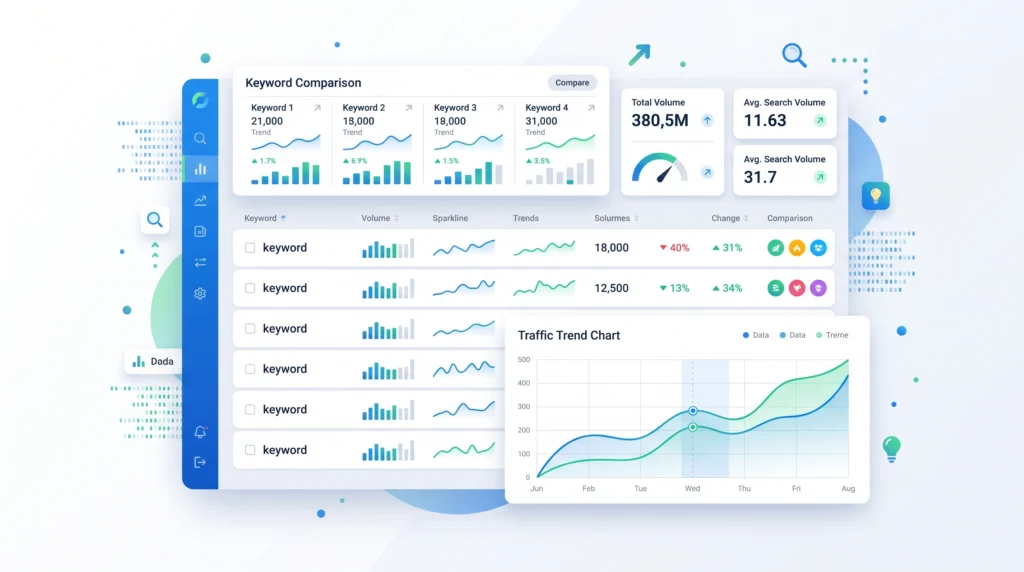
Search volume estimates how often a keyword is searched during a particular period.
It can help you understand the level of interest around a topic.
But don’t make the mistake of choosing keywords based only on search volume.
A keyword with high volume may also have:
- High competition
- Broad intent
- Low relevance
- Low business value
A smaller keyword can sometimes attract more relevant visitors.
Think about:
Volume + Relevance + Intent + Competition + Value
Step 8: Analyze Keyword Difficulty
Keyword difficulty estimates how challenging it may be to rank for a keyword.
Highly competitive keywords can require stronger:
- Content
- Website authority
- Backlinks
- Technical foundations
- Topical coverage
If your website is new, you may want to identify relevant keywords with more realistic competition.
However, don’t reject a keyword solely because a tool gives it a high difficulty score.
Use difficulty as one data point, not the entire decision.
For more information, see:
Article 9 — Keyword Difficulty: What It Is & How to Choose the Right Keywords
Step 9: Find Long-Tail Keywords

Long-tail keywords are more specific search phrases.
For example:
Broad:
SEO
More specific:
SEO for small businesses
Long-tail:
How to do SEO for a small business website
Long-tail keywords can reveal clearer search intent and specific user needs.
For a detailed guide, link to:
Article 8 — Long-Tail Keywords: Complete Guide
Step 10: Group Related Keywords
Once you’ve collected keyword ideas, organize them into groups.
For example:
Main Topic
Keyword Research
Supporting Keywords
- What is keyword research?
- How to do keyword research
- Keyword research tools
- Keyword difficulty
- Search intent
- Long-tail keywords
- Search volume
These related keywords can become part of a keyword cluster.
Grouping keywords helps you organize your website and content strategy.
Step 11: Choose Your Primary Keyword
Each important page should have a clear primary topic.
For this article, the primary keyword is:
How to Do Keyword Research
Supporting terms include:
- keyword research guide
- keyword research process
- SEO keyword research
- keyword research for beginners
- keyword analysis
Your primary keyword should clearly represent the main purpose of the page.
Don’t force unrelated keywords onto the same page simply because they have search volume.
Step 12: Create a Keyword Map

A keyword map connects keywords with the pages you plan to create.
For example:
| Keyword | Search Intent | Suggested Page |
|---|---|---|
| What is keyword research | Informational | Beginner guide |
| How to do keyword research | Informational | Step-by-step guide |
| Keyword research tools | Commercial | Tool comparison |
| Best keyword research tools | Commercial | Comparison article |
| Keyword research software | Commercial/Transactional | Product or comparison page |
A keyword map helps prevent multiple pages from competing unnecessarily for the same search intent.
Step 13: Create Content Based on Search Intent
Now it’s time to create the actual content.
The page should:
- Answer the main question
- Match search intent
- Cover useful related topics
- Use keywords naturally
- Be easy to read
- Provide original value
- Help the reader accomplish their goal
Don’t write content just to reach a specific word count.
Write enough to satisfy the searcher’s need.
Step 14: Optimize Your Content Naturally

Use relevant keywords naturally in places where they help users understand the page.
Potential areas include:
- Page title
- Main heading
- Subheadings
- Introduction
- Body content
- Image alt text when descriptive and appropriate
- Internal link anchor text
But don’t force keywords into every sentence.
Natural language comes first.
Step 15: Measure and Improve
Keyword research doesn’t end when you publish the page.
Monitor how the page performs.
Look at metrics such as:
- Impressions
- Clicks
- Click-through rate
- Organic traffic
- Search queries
- Conversions
- Engagement signals
If the page isn’t performing as expected, investigate why.
Maybe:
- The intent is wrong
- The topic needs more depth
- The title could be clearer
- The content needs updating
- Internal links are missing
- The keyword is too competitive
SEO is an ongoing process.
A Simple Keyword Research Example
Let’s say you have a website about SEO.
Your broad topic is:
Keyword Research
You brainstorm:
- Keyword research
- What is keyword research?
- How to do keyword research
- Keyword research tools
- Keyword difficulty
- Long-tail keywords
You then analyze:
Relevance: High
Intent: Mostly informational
Competition: Varies by keyword
Business value: Depends on your website and audience
You group related terms and create a content plan.
Your final structure could be:
Pillar: Keyword Research
Article: What Is Keyword Research?
Article: How to Do Keyword Research
Article: What Is Search Intent?
Article: Long-Tail Keywords
Article: Keyword Difficulty
This creates a logical topic cluster.
Common Keyword Research Mistakes
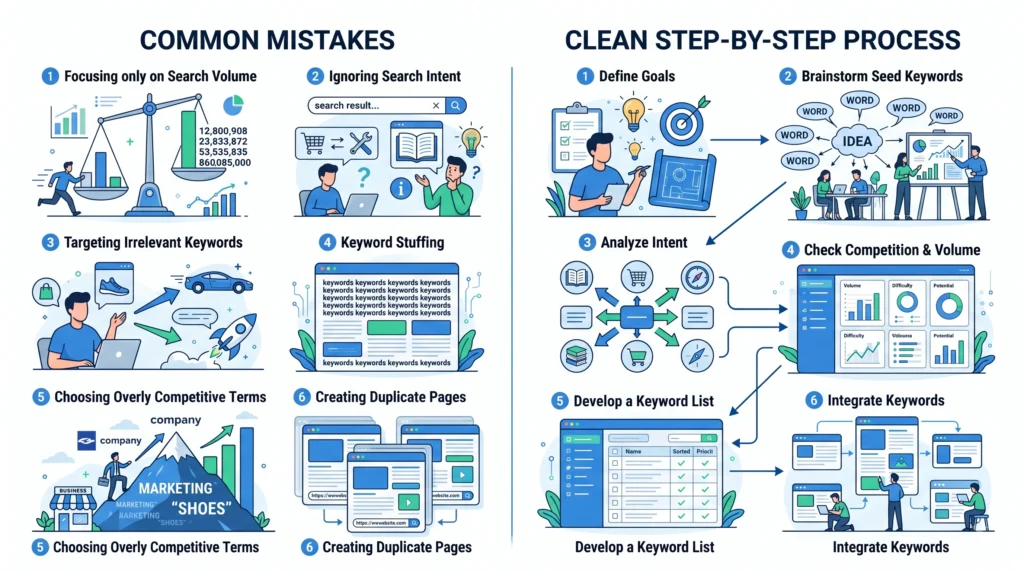
Choosing Keywords Only by Search Volume
High search volume doesn’t automatically mean high value.
Ignoring Search Intent
A keyword may look relevant but have a different intent than your planned content.
Targeting Only Highly Competitive Keywords
New websites may struggle to compete immediately for broad, competitive terms.
Keyword Stuffing
Repeating keywords unnaturally can make content difficult to read.
Targeting Irrelevant Keywords
Traffic is not useful when visitors don’t need your content or services.
Creating Multiple Pages for the Same Intent
Avoid creating several pages that provide essentially the same answer.
Keyword Research Checklist
Use this checklist before creating an SEO page.
Research
- Choose a relevant topic
- Brainstorm keyword ideas
- Use search suggestions
- Find related questions
- Research competitors
Analyze
- Check search intent
- Review search volume
- Analyze keyword difficulty
- Check relevance
- Consider business value
Organize
- Group related keywords
- Identify primary keywords
- Identify supporting keywords
- Build keyword clusters
- Create a keyword map
Create
- Match search intent
- Create useful content
- Use keywords naturally
- Structure the page clearly
- Add relevant internal links
Improve
- Monitor search performance
- Review organic traffic
- Analyze search queries
- Update content when necessary
- Improve weak sections
Frequently Asked Questions
How Do I Do Keyword Research?
Start with a broad topic, generate keyword ideas, analyze search intent, check search demand and competition, group related keywords, choose your primary targets, and create useful content around them.
What Is the First Step in Keyword Research?
The first step is choosing a relevant broad topic that matches your website, audience, business, or area of expertise.
Which Keyword Research Tool Is Best?
There isn’t one tool that is best for every website. Different tools provide different data and features. Choose a tool that gives you the information you actually need for your SEO strategy.
Should Beginners Target Long-Tail Keywords?
Long-tail keywords can be useful for beginners because they are more specific and often communicate clearer search intent. However, every keyword should still be evaluated for relevance and competition.
How Many Keywords Should I Target on One Page?
There is no fixed number.
Focus on one primary topic and naturally cover closely related terms and questions that help satisfy the searcher’s intent.
Is Keyword Research Still Important in 2026?
Yes.
Search behavior continues to evolve, but understanding what users are looking for remains an important part of creating relevant search-focused content.
Can I Do Keyword Research Without Paid Tools?
Yes.
You can start with search suggestions, related searches, competitor research, customer questions, existing website data, and other free sources. Paid tools can provide additional data and efficiency.
Final Thoughts
Learning how to do keyword research doesn’t have to be complicated.
The process becomes much easier when you break it into clear steps:
Choose a Topic
↓
Find Keyword Ideas
↓
Analyze Search Intent
↓
Check Search Demand
↓
Evaluate Competition
↓
Find Long-Tail Keywords
↓
Group Related Keywords
↓
Choose Primary Keywords
↓
Create Helpful Content
↓
Measure and Improve
The biggest mistake beginners make is thinking keyword research is simply about finding popular keywords.
It isn’t.
Effective keyword research is about finding the right opportunities for your audience, website, and goals.
Remember:
Right Keyword + Right Intent + Right Content = Better SEO Opportunity
Related Articles
Article 5:
What Is Keyword Research?what-is-keyword-research
Article 7:
What Is Search Intent?search-intent
Article 8:
Long-Tail Keywords: Complete Guidelong-tail-keywords
Article 9:
Keyword Difficulty: What It Is & How to Choose the Right Keywordskeyword-difficulty
Internal Linking Suggestions
Use natural anchor text such as:
- what is keyword research
- search intent
- long-tail keywords
- keyword difficulty
- keyword research
Link this article back to the main Pillar 2 — Keyword Research page.
Also link to Articles 5, 7, 8, and 9 where relevant.
Publishing Checklist
- H1 used once
- H2 headings clearly labelled
- H3 headings clearly labelled
- Focus keyword included naturally
- SEO title prepared
- Meta title prepared
- Meta description prepared
- URL slug prepared
- Positive words included naturally
- Caution words included naturally
- Keyword research process explained
- Step-by-step process included
- Search intent explained
- Search volume explained
- Keyword difficulty explained
- Long-tail keywords explained
- Keyword clustering explained
- Keyword mapping explained
- Competitor research included
- Common mistakes included
- Beginner strategy included
- FAQs included
- Image placements marked
- Image prompts included
- Image filenames included
- Alt text included
- Internal linking planned
- No keyword stuffing
- No guaranteed ranking claims
- Content is beginner-friendly
- Content is easy to scan
- Content provides genuine value
