
What Is Search Intent?
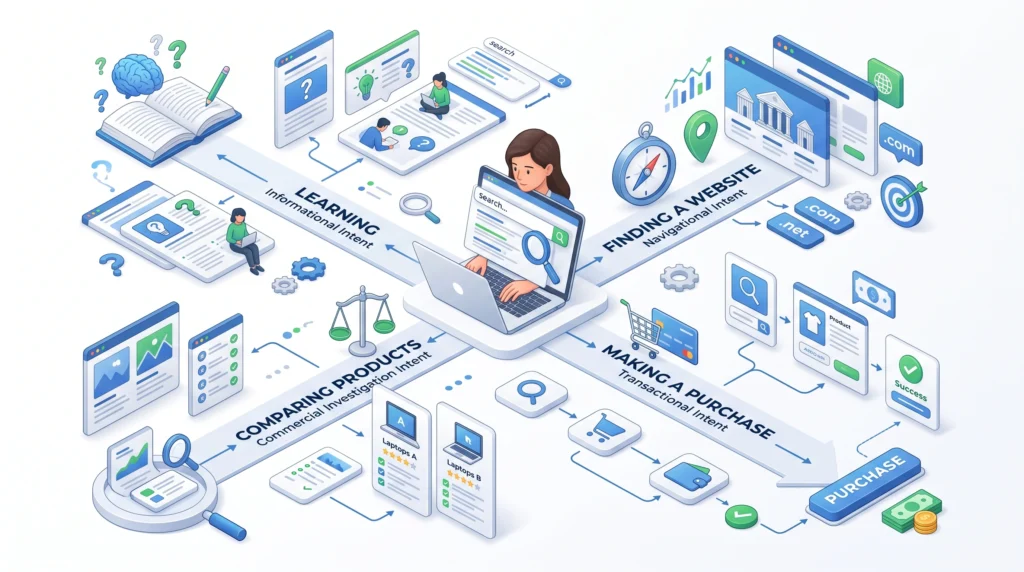
Search intent is the reason or purpose behind a user’s search query.
In simple words, it answers one important question:
“What does this person actually want?”
For example, someone searching:
“What is SEO?”
probably wants to learn.
Someone searching:
“Ahrefs”
may want to find a specific website or brand.
Someone searching:
“Best SEO tools”
may be comparing different options.
And someone searching:
“Buy SEO software”
is showing a stronger intention to purchase.
The words in a search query provide clues, but understanding the intent behind those words helps you create content that better satisfies the searcher.
Why Is Search Intent Important for SEO?
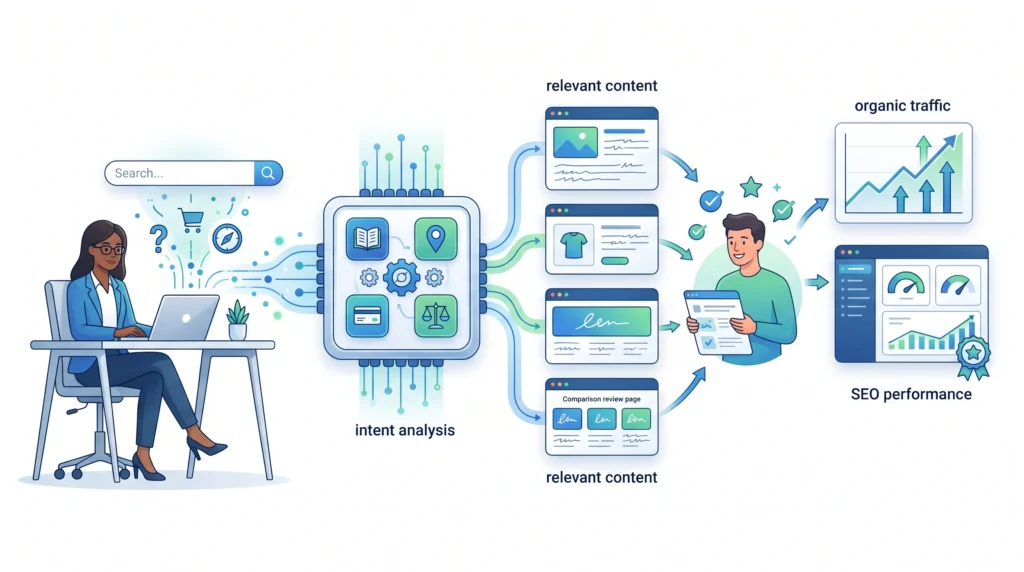
Search engines aim to provide results that are useful and relevant to what users are looking for.
If your page targets a keyword but doesn’t satisfy the underlying intent, it may not be the best result for that search.
For example, imagine someone searches:
“How to do keyword research”
They probably expect a guide or tutorial.
If your page is instead a sales page for an SEO tool, it may not fully satisfy that informational need.
Matching search intent helps you decide:
- What type of page to create
- What information to include
- How detailed the content should be
- What questions to answer
- Which format may work best
- Where the user is in the decision process
The 4 Main Types of Search Intent
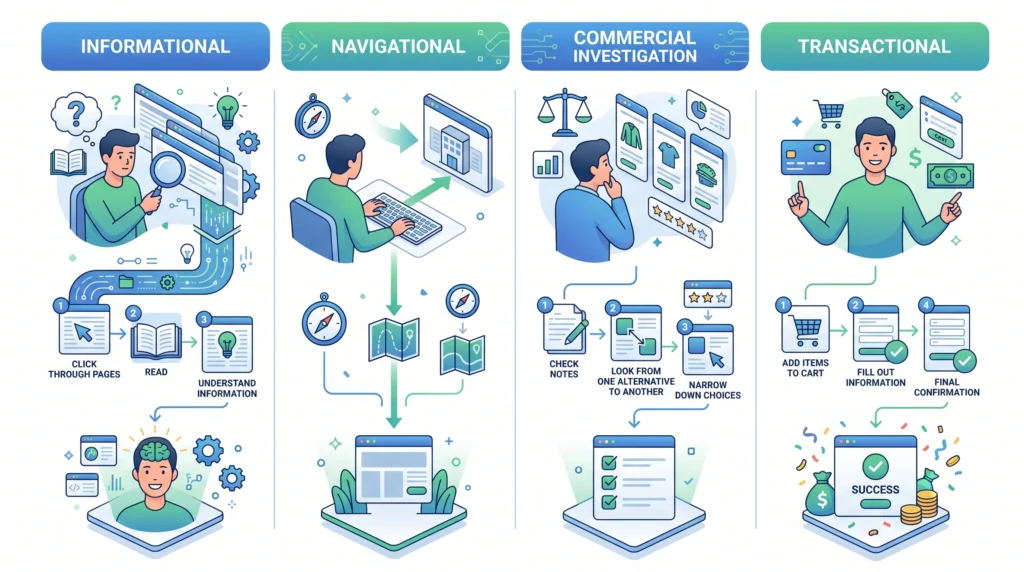
The four commonly used categories are:
- Informational intent
- Navigational intent
- Commercial investigation intent
- Transactional intent
Let’s understand each one.
What Is Informational Search Intent?
Informational intent means the user wants to learn something, find an answer, or understand a topic.
Examples include:
- What is SEO?
- How does keyword research work?
- How to improve website speed
- What are long-tail keywords?
- Why is SEO important?
The user isn’t necessarily ready to buy anything.
They primarily want information.
Best Content Types for Informational Intent
Common formats include:
- Beginner guides
- Tutorials
- How-to articles
- Explanations
- Definitions
- Checklists
- Step-by-step guides
- Educational videos
The key is to answer the user’s question clearly and completely.
What Is Navigational Search Intent?
Navigational intent means the user wants to find a particular website, brand, page, or resource.
Examples include:
- Google Search Console
- Ahrefs login
- YouTube
- Google Analytics
The user may already know where they want to go.
They are using the search engine as a navigation tool.
How to Optimize for Navigational Intent
Make sure your website has:
- Clear brand information
- Easily accessible important pages
- Descriptive page titles
- Clear navigation
- A recognizable website structure
If someone searches specifically for your brand, your official pages should be easy to find.
What Is Commercial Search Intent?
Commercial intent, often called commercial investigation, means the user is researching options before making a decision.
The person may be interested in purchasing something but isn’t necessarily ready yet.
Examples:
- Best SEO tools
- Best keyword research software
- Ahrefs vs Semrush
- Best SEO tools for beginners
- SEO software reviews
The user is usually comparing:
Options → Features → Benefits → Prices → Reviews → Alternatives
Best Content Types for Commercial Intent
Useful formats include:
- Comparison articles
- Reviews
- Product roundups
- Alternatives pages
- Feature comparisons
- Buying guides
The content should help users make an informed decision rather than simply pushing them toward a purchase.
What Is Transactional Search Intent?
Transactional intent means the user is ready—or relatively close—to take an action.
That action could be:
- Buying a product
- Signing up for a service
- Starting a subscription
- Booking something
- Downloading a resource
Examples:
- Buy SEO software
- SEO tool pricing
- Subscribe to SEO software
- Buy keyword research tool
These searches often have strong commercial value.
Best Content Types for Transactional Intent
Examples include:
- Product pages
- Service pages
- Pricing pages
- Landing pages
- Sign-up pages
- Checkout pages
The page should make the intended action clear and easy.
How to Identify Search Intent
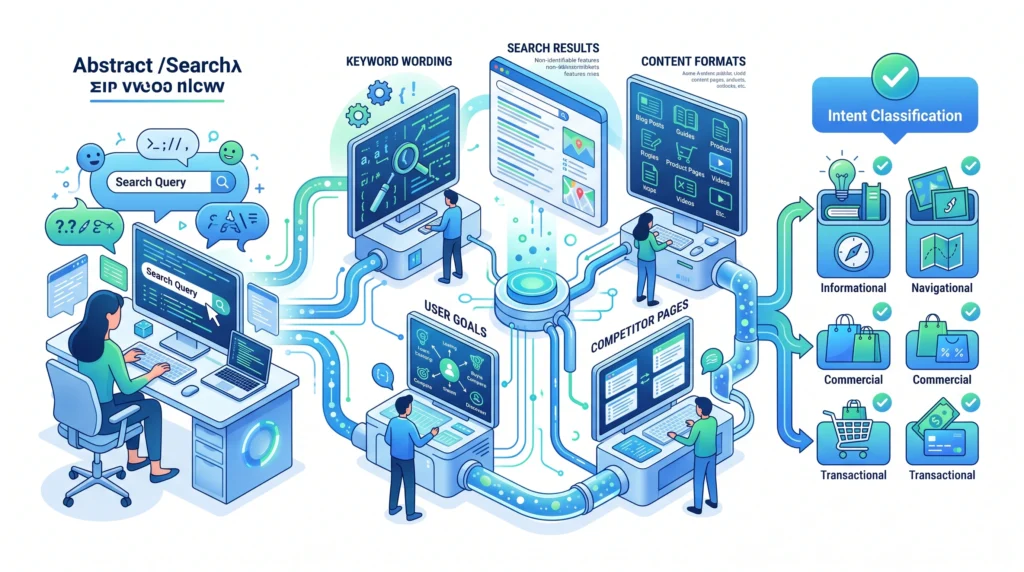
There are several practical ways to identify intent.
Look at the Keyword
Certain words provide strong clues.
Words such as:
what, why, how, guide, tutorial
often suggest informational intent.
Words such as:
best, review, comparison, vs, alternatives
often suggest commercial investigation.
Words such as:
buy, price, order, discount, purchase
often suggest transactional intent.
Words that include a specific brand or website may indicate navigational intent.
However, don’t rely only on individual words.
Analyze the Search Results
One of the most useful ways to understand search intent is to examine the current search results for your target query.
Look at:
- Page types
- Titles
- Content formats
- Featured results
- Product pages
- Guides
- Comparisons
- Videos
- Other SERP features
If most results are detailed guides, that is a strong signal that the query has informational intent.
If most results are product pages, the query may have transactional intent.
The search results provide useful clues about what search engines are currently serving for that query.
Study What Competitors Are Publishing

Study the pages that already rank for your target query.
Ask:
- What type of page ranks?
- Is it a guide?
- Is it a product page?
- Is it a comparison?
- Is it a category page?
- How detailed is the content?
- What questions does it answer?
- What format does it use?
You don’t need to copy competing pages.
Instead, use them to understand the content expectations behind the query and then create something genuinely useful.
Search Intent and the Customer Journey
Search intent can also change as a person moves through the buying journey.
For example:
Awareness
“What is SEO?”
The person is learning.
Research
“How to improve SEO?”
The person is exploring solutions.
Comparison
“Best SEO tools for beginners”
The person is evaluating options.
Decision
“SEO tool pricing”
The person may be closer to taking action.
This means different keywords can require different content strategies.
Search Intent and Content Format
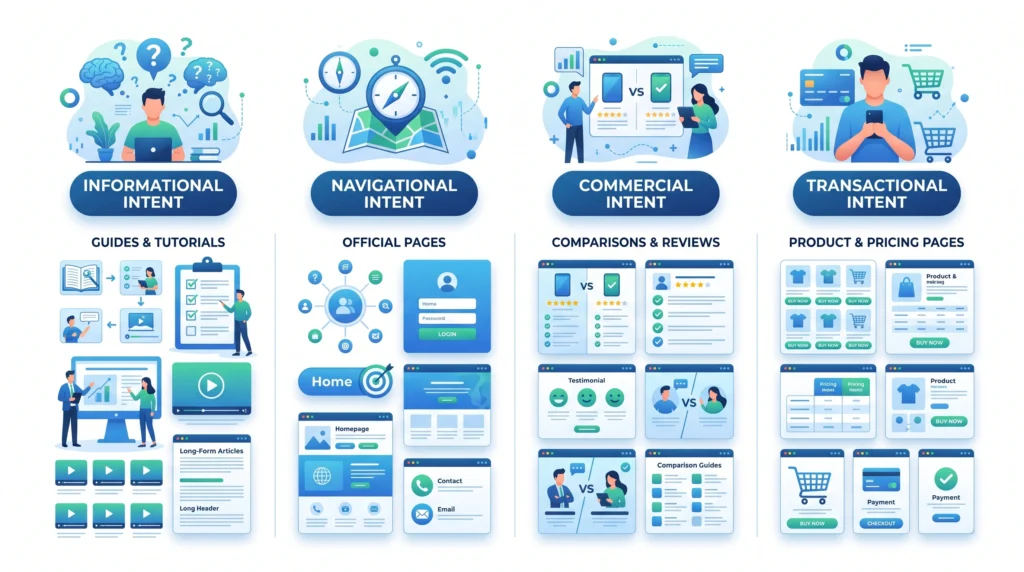
Different search intents often work best with different content formats.
| Search Intent | Common Content Format |
|---|---|
| Informational | Guide, tutorial, explanation |
| Navigational | Homepage, brand page, official resource |
| Commercial | Comparison, review, alternatives |
| Transactional | Product, service, pricing page |
This isn’t an absolute rule.
Search results can vary by topic.
The important thing is to understand the searcher’s goal and create a page that satisfies it.
How to Optimize Content for Search Intent
Once you understand the intent, make your content match it.
Match the Main Question
Answer the question the user is actually asking.
Use the Right Format
If users need a tutorial, provide a tutorial.
If they are comparing products, provide a useful comparison.
Cover Important Subtopics
Include information that helps the user complete their task or understand the subject.
Keep the Content Clear
Don’t bury the answer under unnecessary introductions.
Add Helpful Internal Links
Link users to related resources when they need more information.
Provide a Useful Next Step
Where appropriate, guide the reader toward the next logical action.
Common Search Intent Mistakes
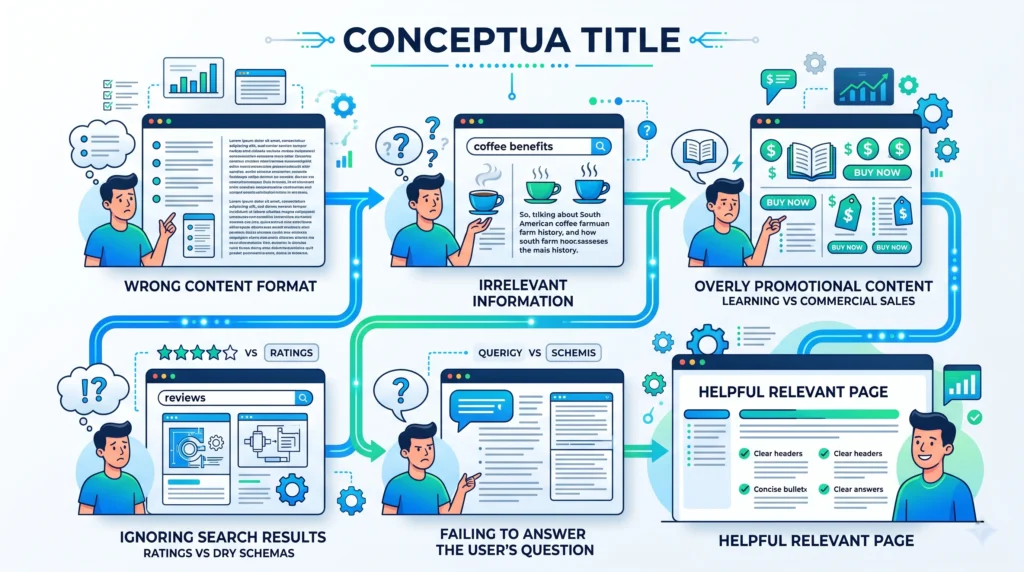
Targeting a Keyword Without Understanding Intent
A keyword may look attractive but still be wrong for your page.
Using the Wrong Content Type
A product page may not satisfy someone looking for a detailed educational guide.
Making Informational Content Too Promotional
Someone searching for an answer usually wants the answer first.
Ignoring the Search Results
The existing SERP can provide valuable clues about intent.
Focusing Only on Keywords
Keywords matter, but understanding the user’s actual need is more important than repeating a phrase.
Trying to Satisfy Every Intent on One Page
A single page doesn’t always need to target every possible intent.
Keep the page focused on its primary purpose.
Search Intent for Beginners: Simple Strategy
If you’re new to SEO, use this simple process:
1. Choose a keyword.
2. Search for it.
3. Study the results.
4. Identify the dominant intent.
5. Look at the content formats ranking.
6. Create content that satisfies that intent.
7. Make the content more useful and complete.
This simple approach can prevent one of the biggest SEO mistakes:
Creating the wrong page for the right keyword.
Search Intent vs Keyword Research
Keyword research tells you:
“What are people searching for?”
Search intent tells you:
“Why are they searching for it?”
You need both.
For example:
Keyword: Best SEO tools
Intent: Commercial investigation
Likely content: Comparison or buying guide
This combination makes keyword research much more useful for content planning.
Frequently Asked Questions
What Is Search Intent in SEO?
Search intent is the reason behind a user’s search query and what they expect to find in the search results.
What Are the 4 Types of Search Intent?
The four commonly used categories are informational, navigational, commercial investigation, and transactional intent.
Why Is Search Intent Important?
It helps you create content that matches what users are actually looking for, improving relevance and the overall usefulness of your page.
How Do I Find Search Intent?
Search the target keyword and analyze the current results, page types, titles, content formats, and information being provided.
What Is Informational Search Intent?
Informational intent means the user wants to learn something, answer a question, understand a topic, or solve a problem.
What Is Commercial Search Intent?
Commercial investigation intent means the user is researching products, services, brands, or solutions before making a decision.
What Is Transactional Search Intent?
Transactional intent indicates that a user is ready or relatively close to taking an action such as purchasing, signing up, booking, or ordering.
Can One Keyword Have More Than One Intent?
Yes.
Some queries can have mixed or overlapping intent. In those cases, examine the search results and determine which intent appears to dominate.
Does Search Intent Affect SEO Rankings?
Search intent is important because search engines aim to provide results that are relevant and useful for users. Creating content that satisfies the intent behind a query can improve the relevance and usefulness of your page.
Final Thoughts
Search intent is one of the most important concepts to understand when learning SEO.
Keyword research tells you what people search for.
Search intent helps you understand why they search for it.
That difference can completely change the content you should create.
Before targeting a keyword, ask:
What does the searcher want?
Then ask:
What type of content would best satisfy that need?
A simple formula to remember is:
Keyword → Intent → Content Format → Useful Answer → Better User Experience
Don’t create content just because a keyword has search volume.
Create content because you understand the person behind the search and can give them a useful, relevant answer.
Related Articles
Article 5:
What Is Keyword Research?what-is-keyword-research
Article 6:
How to Do Keyword Research Step by Stepkeyword-research-guide
Article 8:
Long-Tail Keywords: Complete Guidelong-tail-keywords
Article 9:
Keyword Difficulty: What It Is & How to Choose the Right Keywordskeyword-difficulty
Internal Linking Suggestions
Use natural anchor text such as:
- keyword research
- how to do keyword research
- long-tail keywords
- keyword difficulty
- SEO keyword research
Link this article back to the main Pillar 2 — Keyword Research page.
Also link to Articles 5, 6, 8, and 9 where relevant.
Publishing Checklist
- H1 used once
- H2 headings clearly labelled
- H3 headings clearly labelled
- Focus keyword included naturally
- SEO title prepared
- Meta title prepared
- Meta description prepared
- URL slug prepared
- Positive words included naturally
- Caution words included naturally
- Search intent clearly explained
- Four main intent types explained
- Informational intent explained
- Navigational intent explained
- Commercial intent explained
- Transactional intent explained
- Search results analysis explained
- Competitor analysis explained
- Content formats explained
- Customer journey explained
- Search intent optimization explained
- Common mistakes included
- Beginner strategy included
- FAQs included
- Image placements marked
- Image prompts included
- Image filenames included
- Alt text included
- Internal linking planned
- No keyword stuffing
- No guaranteed ranking claims
- Content is beginner-friendly
- Content is easy to scan
- Content provides genuine value
