

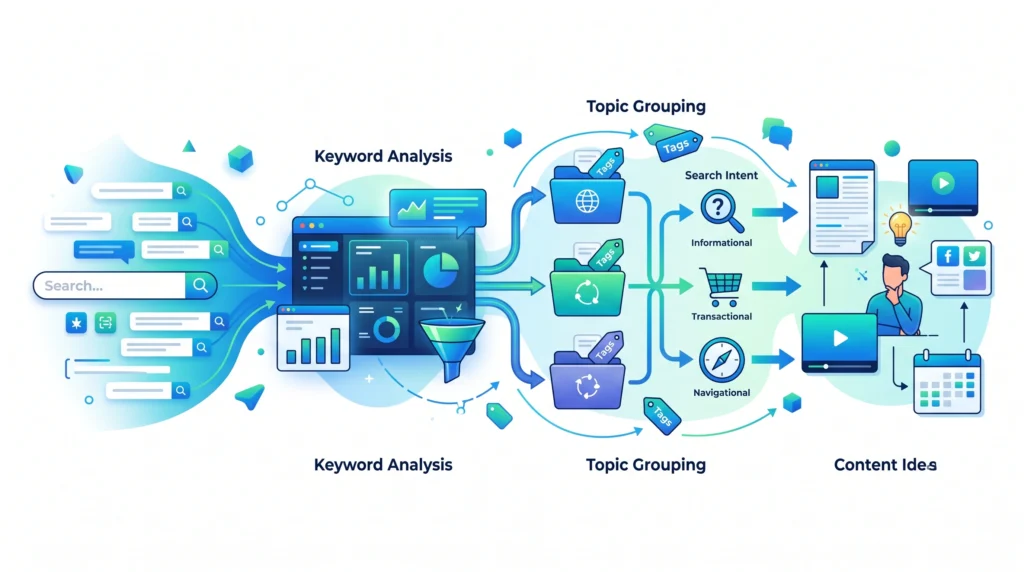
Keyword research is the process of discovering and analyzing the words, phrases, and questions people use when searching online.
It helps you understand what your target audience is looking for and what topics may be relevant to create content around.
For example, someone interested in learning SEO might search for:
- What is SEO?
- How does SEO work?
- What is keyword research?
- How to do keyword research
- What is search intent?
These searches provide clues about what people want to know.
Keyword research helps turn those clues into a content strategy.
In simple terms:
Keyword research helps you understand what your audience is searching for so you can create content that addresses their needs.
It is not about finding a keyword and repeating it as many times as possible.
Effective keyword research involves understanding topics, search intent, audience needs, competition, and the type of content people expect to find.
What Is a Keyword in SEO?
A keyword is a word or phrase that represents what someone is searching for.
For example:
SEO
This is a broad keyword.
But someone may search for:
What is SEO for beginners?
This is a more specific search query.
Keywords can include:
- Single words
- Short phrases
- Long phrases
- Questions
- Product names
- Service-related terms
- Problem-based searches
In SEO, keywords help identify the language people use when looking for information online.
However, a keyword alone does not tell the complete story.
You also need to understand why someone is searching for that keyword.
That is where search intent becomes important.
Keyword vs Search Query
A keyword and a search query are closely related, but they are not always exactly the same thing.
A search query is the exact phrase a person enters into a search engine.
For example:
how do I find keywords for my website
A keyword may be a shorter or broader representation of that topic:
keyword research
When performing keyword research, you may analyze both individual keywords and the wider collection of searches related to a topic.
This helps you understand the broader search landscape.
Why Is Keyword Research Important?
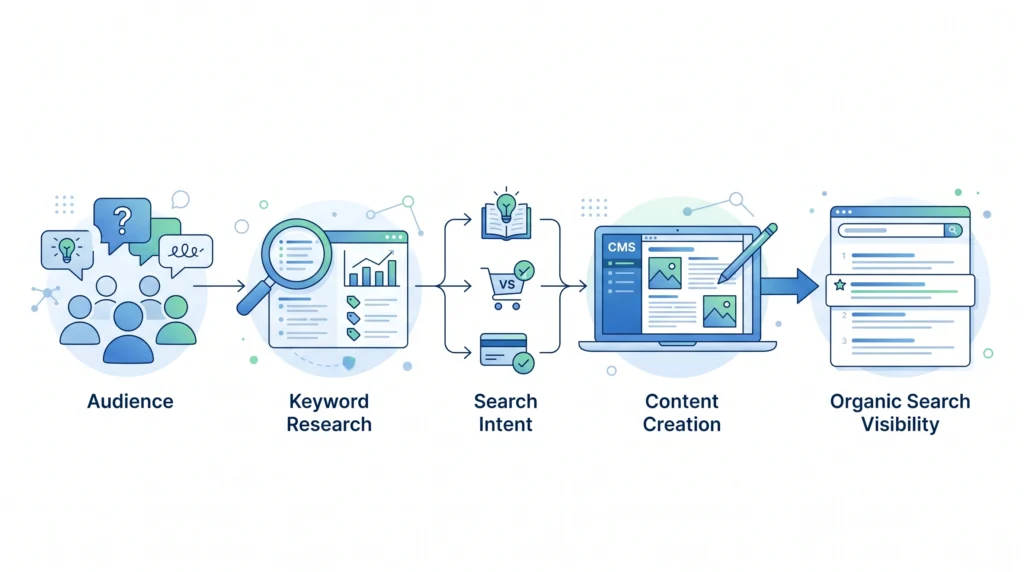
Keyword research is important because it helps you make more informed decisions about the content you create.
It can help you:
- Understand what your audience searches for
- Discover new content ideas
- Identify relevant topics
- Understand search intent
- Find specific questions people ask
- Organize content into topic clusters
- Improve content relevance
- Identify opportunities your website may be able to address
Without keyword research, you may create content based only on assumptions.
Research gives you additional information about actual search behavior.
How Does Keyword Research Work?
Keyword research generally follows a simple process:
Start with a Topic
↓
Find Related Keywords
↓
Analyze Search Intent
↓
Evaluate Relevance
↓
Review Competition and Opportunities
↓
Group Similar Keywords
↓
Create Useful Content
For example, imagine your website focuses on SEO.
You may start with the broad topic:
Keyword Research
Then discover related searches such as:
- What is keyword research?
- How to do keyword research
- Keyword research tools
- Long-tail keywords
- Keyword difficulty
- Search intent
These can become individual articles or sections within a larger guide.
The goal is not to create a separate page for every small keyword variation.
The goal is to understand which searches belong to the same topic and which deserve their own content.
The Main Types of Keywords
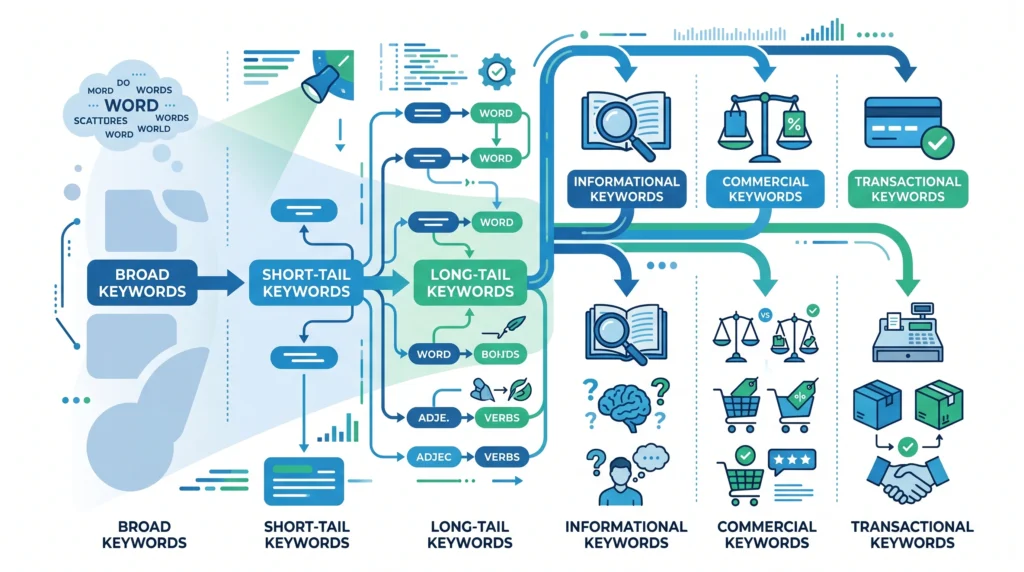
Keywords can be categorized in several ways.
Short-Tail Keywords
Short-tail keywords are usually broad and relatively short.
Example:
SEO
Because they are broad, the exact intent behind them can be unclear.
A person searching for “SEO” could want a definition, a course, a tool, an agency, or something else.
Long-Tail Keywords
Long-tail keywords are generally more specific phrases.
Example:
How to do keyword research for a new website
This query gives you a clearer idea of what the searcher wants.
Long-tail keywords can be particularly useful for understanding specific audience needs.
Informational Keywords
These searches are usually made by people looking for information.
Examples:
- What is SEO?
- How does keyword research work?
- What is search intent?
Commercial Keywords
These searches often involve research before making a decision.
Examples:
- Best keyword research tools
- Ahrefs vs Semrush
- Best SEO software for beginners
Transactional Keywords
These searches suggest that someone may be ready to take action.
Examples:
- Buy SEO tool
- Hire SEO consultant
- SEO agency pricing
What Is Search Intent?
Search intent is the reason behind a search.
Understanding keywords without understanding intent can lead to the wrong type of content.
For example:
Someone searching:
What is keyword research?
is likely looking for an explanation.
Someone searching:
best keyword research tools
is likely comparing options.
Someone searching:
keyword research service pricing
may be looking for a service.
These searches all contain the phrase keyword research, but the user’s goal is different.
This is why keyword research and search intent should work together.
For a detailed explanation, see:
Article 7 — What Is Search Intent?
How to Find Keyword Ideas
You can find keyword ideas in several ways.
Start With Your Main Topic
Begin with the main subject of your website or content.
For example:
SEO
Then explore related areas:
- Keyword research
- On-page SEO
- Technical SEO
- Link building
Think About Audience Questions
Consider the questions your audience may ask.
For example:
- How does SEO work?
- Why is keyword research important?
- How long does SEO take?
Analyze Search Results
Search results can provide clues about:
- Content formats
- Common questions
- Related topics
- Search intent
Use Keyword Research Tools
Keyword research tools can help identify:
- Related keywords
- Search volume estimates
- Competition metrics
- Keyword suggestions
- Topic ideas
Different tools may provide different estimates, so use data as guidance rather than absolute truth.
What Makes a Good Keyword?
A good keyword is not simply one with the highest search volume.
The best keyword for your website should be:
Relevant
It should relate closely to your website, business, product, service, or content expertise.
Intent-Aligned
You should be able to create content that matches what the searcher wants.
Valuable
The keyword should have potential value for your goals.
That value might involve:
- Traffic
- Leads
- Sales
- Brand awareness
- Audience growth
- Educational value
Realistic
Consider your website’s current ability to compete.
A highly competitive keyword may require more resources and authority than a new website currently has.
Search Volume and Keyword Difficulty

Keyword research tools often provide metrics such as search volume and keyword difficulty.
Search Volume
Search volume is an estimate of how often a keyword is searched during a specific period.
Higher volume does not automatically mean a keyword is better.
A highly relevant keyword with lower search demand may provide more value than a broad, high-volume keyword that attracts the wrong audience.
Keyword Difficulty
Keyword difficulty is usually a third-party estimate of how difficult it may be to compete for a particular keyword.
Different tools calculate this metric differently.
Use keyword difficulty as a reference point—not as a guaranteed prediction.
Keyword Research and Topic Clusters
Instead of creating content around isolated keywords, think about topics.
For example:
Main Topic: Keyword Research
Supporting topics:
- What is keyword research?
- How to do keyword research
- What is search intent?
- Long-tail keywords
- Keyword difficulty
- Keyword research tools
These pages can form a topic cluster.
The main pillar page provides an overview, while supporting articles explore individual subjects in greater detail.
Internal links can connect these articles and help users navigate the topic.
Common Keyword Research Mistakes
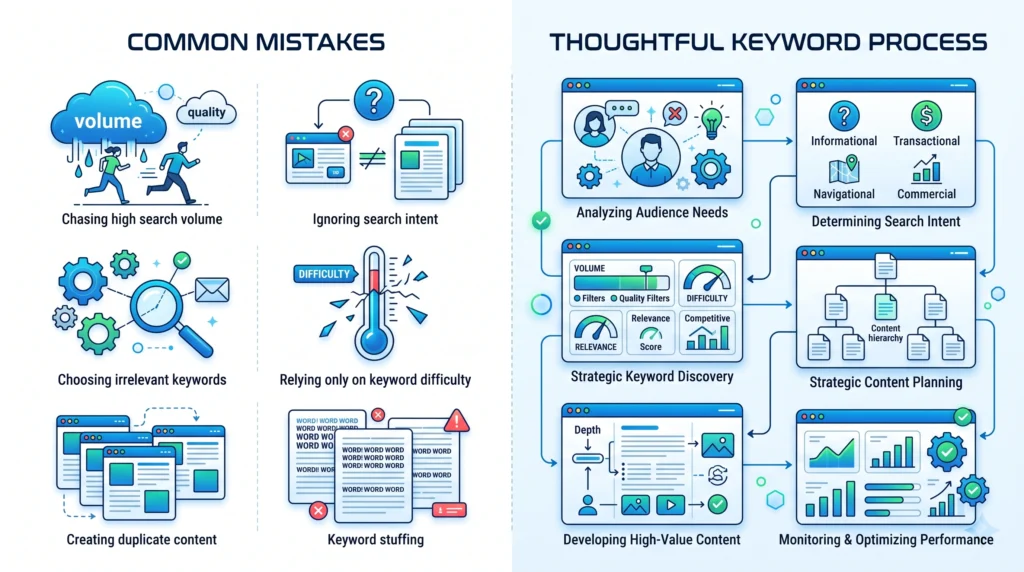
Chasing Search Volume Only
High search volume doesn’t guarantee that a keyword is relevant or valuable.
Ignoring Search Intent
A keyword may look relevant but still require a completely different type of content.
Creating a Page for Every Keyword Variation
Similar searches may be better served by one comprehensive page.
Ignoring Business or Website Relevance
Traffic is not useful if it comes from people who have no interest in your content or offerings.
Keyword Stuffing
Repeating a keyword excessively does not improve content quality.
Use keywords naturally and focus on answering the user’s question.
Relying Completely on Tool Metrics
Keyword tools provide estimates, not perfect predictions.
Combine tool data with your own analysis of search results and audience needs.
How Keyword Research Supports Your SEO Strategy
Keyword research can influence almost every part of an SEO strategy.
It can help you decide:
- What content to create
- Which topics deserve their own pages
- What questions to answer
- Which pages should be connected
- How to organize website content
- What search intent to target
- Which opportunities are most relevant to your goals
In other words:
Keyword research helps you build your content strategy around audience demand instead of guesswork alone.
Simple Keyword Research Process for Beginners
If you are just getting started, follow this process:
Step 1: Choose a Broad Topic
Start with a topic related to your website.
Example:
SEO
Step 2: Find Related Searches
Look for questions, phrases, and related topics.
Step 3: Understand Search Intent
Ask what the searcher is trying to achieve.
Step 4: Check Relevance
Make sure the topic is relevant to your website and audience.
Step 5: Group Similar Keywords
Combine closely related searches that can be answered by the same piece of content.
Step 6: Create Helpful Content
Build content that directly addresses the searcher’s needs.
Step 7: Review and Improve
Monitor performance and continue improving your content as your website grows.
For a detailed process, see:
Article 6 — How to Do Keyword Research Step by Step.
Keyword Research Checklist
Before choosing a keyword or topic, ask:
- Is the keyword relevant to my website?
- Do I understand the search intent?
- Can I create genuinely useful content?
- Does this topic have value for my audience?
- Have I checked related searches?
- Have I considered similar keyword variations?
- Should similar keywords be grouped together?
- Have I reviewed the search results?
- Am I choosing the keyword for relevance—not just volume?
- Can I realistically compete for this topic over time?
- Am I avoiding keyword stuffing?
Frequently Asked Questions
What Is Keyword Research in SEO?
Keyword research is the process of discovering and analyzing the words, phrases, and questions people use when searching online.
Why Is Keyword Research Important?
It helps you understand audience demand, discover relevant topics, identify search intent, and make better content decisions.
What Is a Keyword?
A keyword is a word or phrase associated with what someone searches for online.
What Is the Difference Between a Keyword and a Search Query?
A search query is the exact phrase a user enters into a search engine, while a keyword may represent the broader topic or term being analyzed.
What Are Long-Tail Keywords?
Long-tail keywords are generally more specific search phrases that often provide clearer information about what the searcher wants.
Should I Target High-Volume Keywords?
Not always. Relevance, search intent, potential value, and your ability to compete can be more important than search volume alone.
What Is Keyword Difficulty?
Keyword difficulty is a third-party metric used by SEO tools to estimate how difficult it may be to compete for a keyword. Different tools use different methods.
Can I Do Keyword Research Without Paid Tools?
Yes. You can begin by analyzing your audience, brainstorming questions, reviewing search results, and exploring related topics. Tools can provide additional data and keyword ideas.
Final Thoughts
Keyword research is the foundation of a thoughtful SEO content strategy.
It helps you move from:
Guessing what people want
↓
to
Understanding what people are searching for
↓
to
Creating useful content that matches their needs
The best keyword research is not about finding the biggest number.
It is about finding the right opportunities.
Focus on:
Relevance
Search Intent
Audience Needs
Topic Coverage
Content Quality
Realistic Opportunities
When you understand these elements, keyword research becomes more than a list of search terms.
It becomes a strategic way to understand your audience and create content that genuinely helps them.
Related Articles
Article 6:
How to Do Keyword Research Step by Stepkeyword-research-guide
Article 7:
What Is Search Intent?search-intent
Article 8:
Long-Tail Keywords: Complete Guidelong-tail-keywords
Pillar 1 — SEO Basics:
What Is SEO?what-is-seo
Internal Linking Suggestions
Naturally link this article to:
- What Is SEO?
- How to Do Keyword Research Step by Step
- What Is Search Intent?
- Long-Tail Keywords
- What Is On-Page SEO?
- Internal Linking
Recommended anchor text:
- keyword research
- how to do keyword research
- search intent
- long-tail keywords
- SEO basics
- on-page SEO
- internal linking
Also link this article back to the main Pillar 2 — Keyword Research page.
Publishing Checklist
- H1 clearly labelled
- H2 headings clearly labelled
- H3 headings clearly labelled
- SEO title prepared
- Meta title prepared
- Meta description prepared
- URL slug prepared
- Focus keyword included naturally
- Secondary keywords used naturally
- Positive words included naturally
- Caution words included naturally
- Keywords explained
- Search queries explained
- Search intent explained
- Keyword types included
- Search volume explained
- Keyword difficulty explained
- Topic clusters explained
- Common mistakes included
- Beginner process included
- Keyword checklist included
- FAQs included
- Image placements marked
- Image prompts included
- Image filenames included
- Alt text included
- Internal linking suggestions included
- No keyword stuffing
- No guaranteed ranking claims
- Beginner-friendly language used
- Content is easy to scan
- Content provides genuine value
