
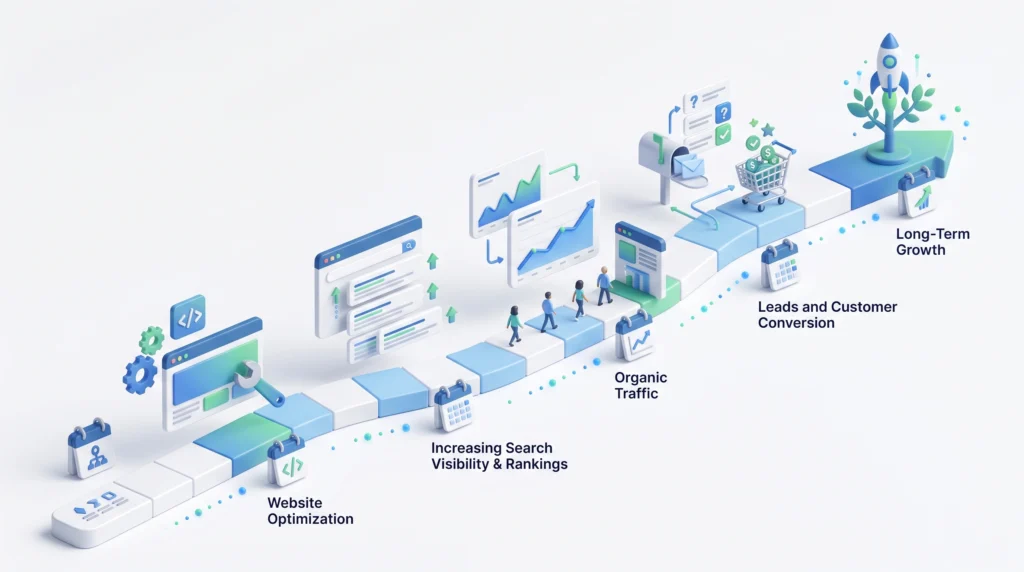
Introduction: How Long Does SEO Take to Work?
One of the first questions almost every SEO beginner asks is:
“How long does SEO take to work?”
The honest answer is:
There is no fixed timeline.
Some websites may start seeing meaningful changes relatively quickly, while others may need several months or longer to build noticeable organic visibility.
The timeline depends on many factors, including:
- Website history
- Competition
- Content quality
- Search demand
- Technical SEO
- Website authority
- Backlink profile
- Search intent
- Industry
- SEO strategy
- Consistency
SEO is usually a gradual process, not an instant marketing trick.
The right goal is not simply to ask:
“When will I rank?”
Instead, ask:
“Am I consistently improving my website’s ability to earn relevant organic visibility?”
Does SEO Work Immediately?
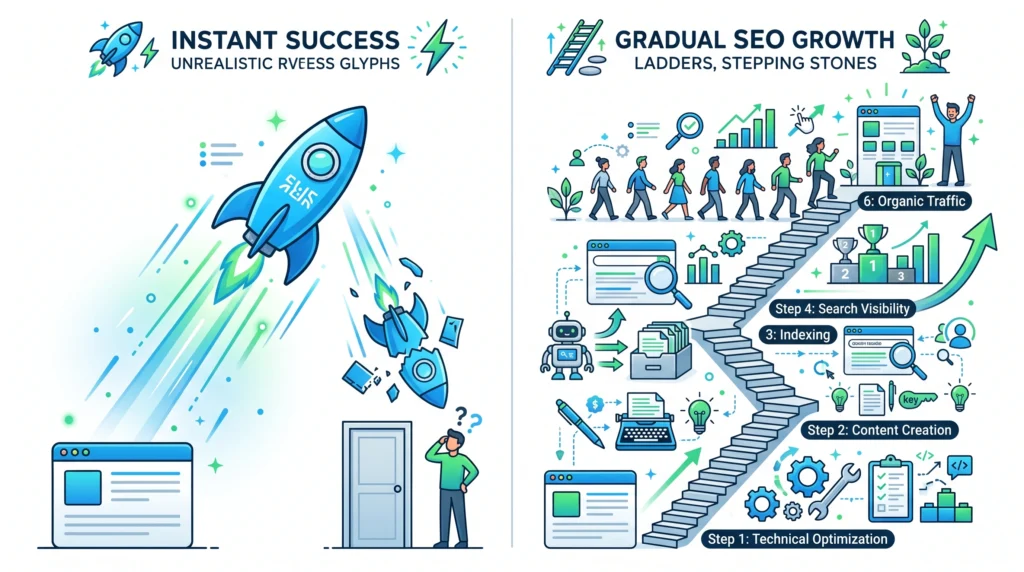
Usually, you should not expect SEO to produce major results immediately.
A newly published page may need to be discovered, crawled, processed, indexed, and eventually evaluated for relevant searches.
Even after a page becomes visible, rankings can change as search systems and competitors interact with the search landscape.
That’s why SEO requires patience.
A Simple SEO Timeline
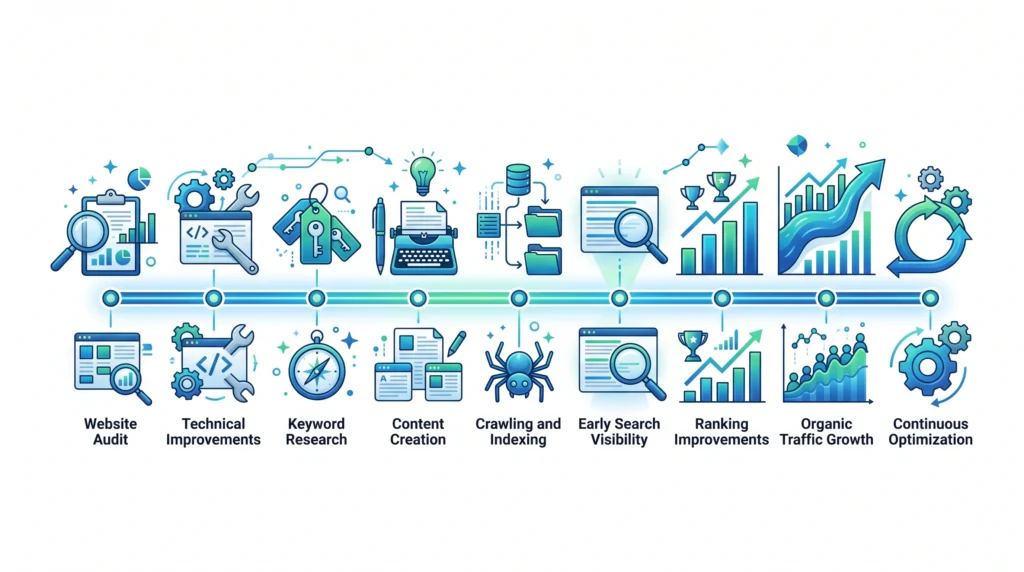
A simple way to think about SEO is:
Stage 1 — Foundation
Technical fixes, website structure, keyword research and strategy.
Stage 2 — Content
Publishing useful and relevant content.
Stage 3 — Discovery
Search engines discover and process the pages.
Stage 4 — Visibility
Pages begin appearing for relevant searches.
Stage 5 — Growth
Successful pages can gain more visibility and organic traffic.
Stage 6 — Improvement
You update, expand and improve the website based on data.
These stages can overlap, and the timeline varies from website to website.
How Long Does SEO Take to Show Results?
There is no universal number of days or months that guarantees SEO results.
However, a realistic SEO strategy should be evaluated over time rather than after only a few days.
Some early signals may appear sooner than major traffic or ranking growth.
For example, you might first notice:
- Pages being discovered
- Pages becoming indexed
- Search impressions increasing
- New keywords appearing
- Small ranking improvements
- Early organic visitors
More meaningful traffic and business results can take longer.
The important thing is to look for consistent positive movement, rather than expecting one dramatic jump.
What Factors Affect How Fast SEO Works?
Several factors can make SEO faster or slower.
1. Website Age and History
A completely new website generally has less history than an established website.
A new domain may need time to build content, visibility, trust, and a useful website structure.
However, website age alone does not guarantee rankings.
An older website can still perform poorly if its content and technical foundations are weak.
2. Competition

Competition has a major effect on SEO difficulty.
Ranking for a specific, highly competitive topic can require significantly more effort than ranking for a narrow topic with less competition.
For example:
“SEO”
is extremely broad and competitive.
A more specific topic such as:
“SEO checklist for a small local bakery”
may have a narrower audience and potentially different competition.
This is why keyword research matters.
3. Content Quality
Useful content can improve your ability to satisfy search intent.
High-quality content should:
- Answer the user’s question
- Provide useful details
- Be easy to understand
- Be well organized
- Avoid unnecessary repetition
- Stay accurate
- Provide genuine value
Publishing many low-quality pages does not automatically produce better SEO.
4. Technical SEO
Technical problems can make it harder for search engines to access, understand, or process your website.
Important areas include:
- Crawlability
- Indexability
- Mobile usability
- Website speed
- HTTPS
- Site architecture
- Internal linking
- Canonicalization
- Structured data where appropriate
A strong technical foundation can support your content strategy.
5. Website Authority and Links
Links can help search engines discover pages and understand relationships across the web.
Relevant, natural links from other websites can also contribute to a site’s overall authority and visibility.
However, SEO is not simply a race to collect the largest number of backlinks.
Quality, relevance, and natural acquisition matter.
6. Search Intent
If your page doesn’t match what people are actually looking for, ranking can be difficult.
For example, someone searching:
“What is SEO?”
probably wants an explanation.
A page selling SEO software without explaining SEO may not satisfy that informational intent.
Matching content to intent is therefore essential.
7. Consistency
SEO is not usually a one-time project.
Websites need:
- New useful content
- Content updates
- Technical maintenance
- Internal linking
- Performance monitoring
- Competitor analysis
- Ongoing improvement
Consistency can be more valuable than short bursts of SEO activity.
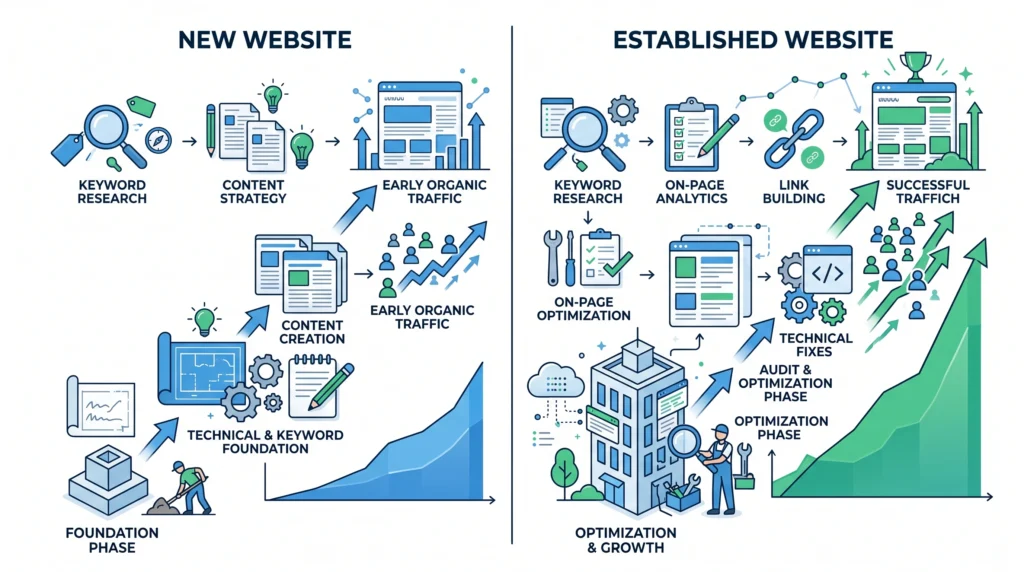
New Website vs Established Website
New Website
A new website may need to establish:
- Content
- Website structure
- Search visibility
- Audience relevance
- Authority
- Technical foundations
Established Website
An established website may already have:
- Existing content
- Search traffic
- Historical data
- Backlinks
- Indexed pages
But an established website can still require significant improvement.
Older does not automatically mean better.
Can SEO Results Happen Faster?
Yes, some SEO improvements can become visible relatively quickly, particularly when fixing clear technical problems or improving existing pages.
For example, if an important page was accidentally blocked from search engine access and the issue is corrected, the page may become eligible for discovery and indexing.
Similarly, improving a poorly optimized existing page can sometimes produce faster changes than building a completely new website from scratch.
But there is no guaranteed speed.
Avoid anyone promising:
“First position in 7 days.”
SEO doesn’t offer reliable guarantees like that.
Why Some SEO Strategies Take Longer
Some SEO projects require more time because they involve competitive topics or substantial website changes.
Examples include:
- Building a new website
- Entering a competitive industry
- Creating a large content library
- Building topical coverage
- Recovering from technical problems
- Improving weak content
- Competing against established websites
The bigger the gap between your website and the competition, the more work may be required.
How to Know If Your SEO Is Working
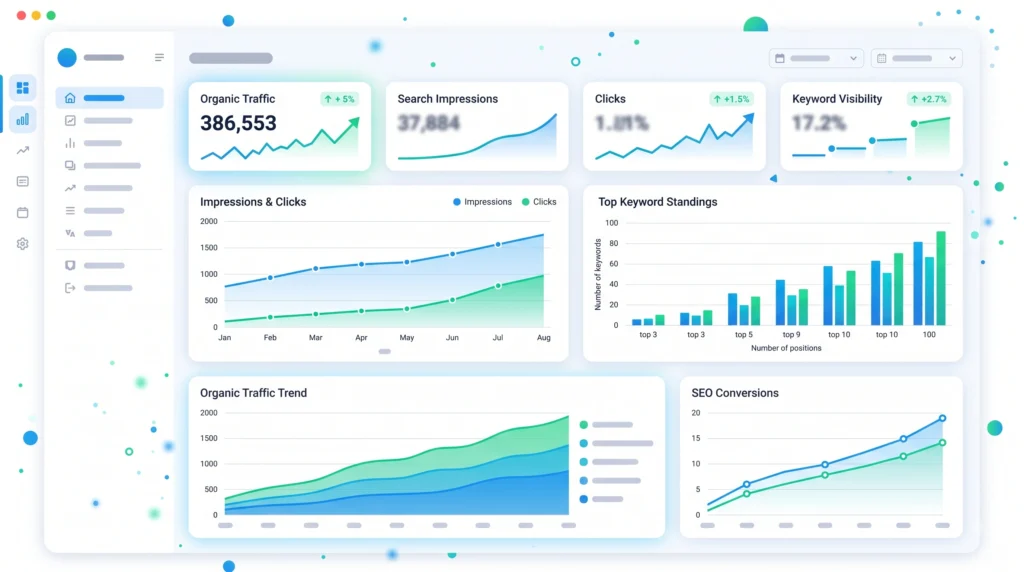
Don’t wait for a huge traffic increase before deciding whether SEO is working.
Look for smaller signals.
Early Signals
- More pages indexed
- More search impressions
- New keywords appearing
- More pages receiving organic traffic
- Improved rankings for some queries
Growth Signals
- Increasing organic traffic
- Better keyword visibility
- More engaged visitors
- More leads
- More conversions
Business Signals
- Qualified leads
- Sales
- Revenue
- Returning customers
SEO success should ultimately connect to your actual goals.
What SEO Metrics Should Beginners Track?
Beginners don’t need to track hundreds of metrics.
Start with:
Organic Clicks
How many users visit your website from organic search?
Impressions
How often are your pages appearing in search?
Average Position
How are your pages performing for tracked search queries?
Organic Traffic
How much traffic comes from search engines?
Conversions
Are organic visitors completing valuable actions?
Revenue
For businesses and ecommerce websites, does organic search contribute to revenue?
The exact metrics should match your goals.
Common SEO Timeline Mistakes
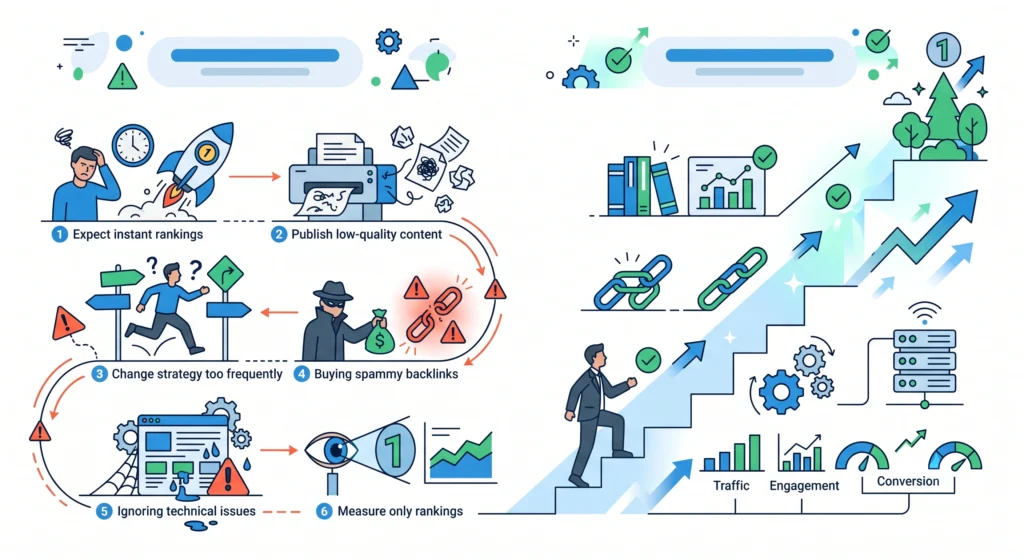
Expecting Instant Rankings
SEO generally takes time.
Changing Strategy Every Week
Constantly changing direction makes it difficult to understand what works.
Publishing Content Without Research
More content isn’t automatically better.
Measuring Only Rankings
Rankings matter, but traffic, leads, conversions, and revenue may matter more.
Giving Up Too Early
Some strategies need enough time and data before you can judge their effectiveness.
How to Make Your SEO Strategy More Effective
Use this simple process:
Research → Create → Optimize → Publish → Measure → Improve
Research
Understand your audience, keywords, competition and search intent.
Create
Build useful content that solves real problems.
Optimize
Improve titles, headings, internal links, content structure and technical foundations.
Publish
Make your content available and ensure important pages can be discovered.
Measure
Monitor search visibility, traffic and business results.
Improve
Update your strategy based on evidence.
Should You Stop SEO If Results Are Slow?
Not necessarily.
Slow results don’t automatically mean SEO isn’t working.
Before abandoning your strategy, ask:
- Are impressions increasing?
- Are more pages being indexed?
- Are rankings improving for some queries?
- Is organic traffic growing?
- Is content satisfying search intent?
- Are technical problems limiting visibility?
- Is the target keyword too competitive?
- Are competitors significantly stronger?
Use data to identify the problem instead of simply assuming SEO has failed.
SEO Is a Long-Term Investment
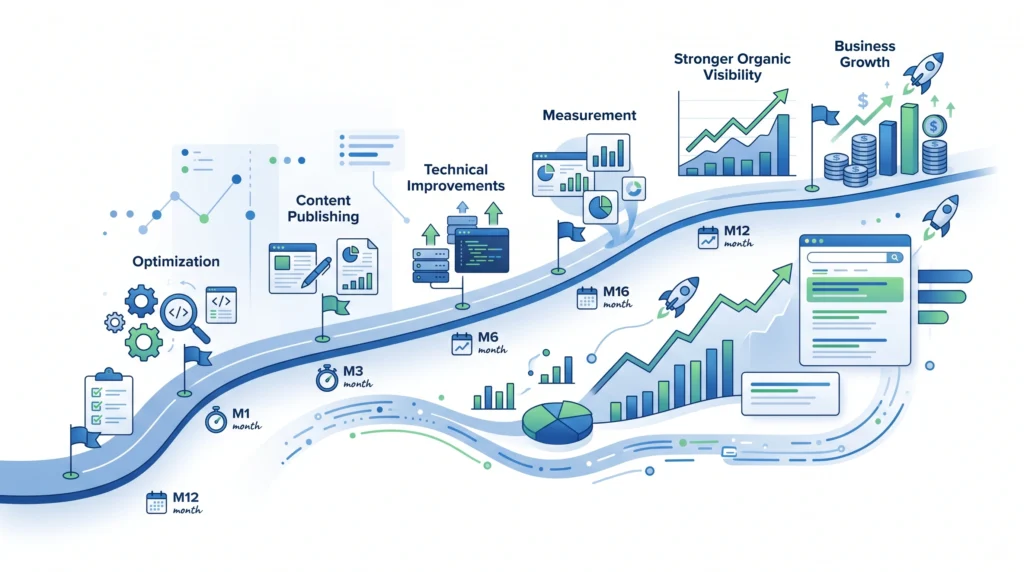
SEO should be treated as a long-term digital asset.
A useful article can continue attracting visitors.
A strong resource can earn links.
A well-structured website can support new content.
A successful topic can lead to related content opportunities.
The work can compound over time.
But that doesn’t mean you can publish once and forget about SEO.
Successful websites continue improving.
Frequently Asked Questions
How Long Does SEO Take to Work?
There is no fixed timeline. SEO results depend on competition, website history, content quality, technical SEO, search intent, links, industry and many other factors.
Can SEO Work in One Month?
Some improvements may become visible within a month, especially after fixing technical problems or optimizing existing pages.
However, major and consistent organic growth may require considerably more time.
Why Is My Website Not Ranking After Months?
Possible reasons include high competition, weak content, poor search-intent alignment, technical problems, insufficient topical coverage, weak internal linking, or other SEO issues.
A detailed website analysis is usually needed to identify the specific problem.
How Long Does It Take to Get SEO Traffic?
There is no guaranteed timeframe.
New websites may need time to establish visibility, while established websites with existing authority and content may see changes sooner.
Does More Content Mean Faster SEO Results?
No.
Publishing more content does not automatically produce faster SEO results.
Useful, relevant, well-targeted content is generally more valuable than publishing large quantities of low-quality content.
Can Technical SEO Improve Results Quickly?
Sometimes.
Fixing a serious technical issue can remove an obstacle that was preventing pages from being crawled, indexed, or properly processed.
However, not every technical improvement produces an immediate ranking increase.
Is SEO Worth the Time?
For many websites, yes.
SEO can provide valuable organic visibility and help businesses reach people who are actively searching for relevant information, products, or services.
Whether it is worth the investment depends on your goals, industry, competition and resources.
Should I Do SEO Every Month?
SEO generally benefits from ongoing monitoring and improvement.
You may need to update content, fix technical issues, research new opportunities, improve internal linking and analyze performance over time.
Final Thoughts
So, how long does SEO take to work?
There isn’t one answer that applies to every website.
SEO can take different amounts of time depending on:
Competition
Website History
Content Quality
Technical SEO
Search Intent
Links
Industry
Consistency
The biggest mistake is expecting SEO to behave like an instant switch.
You publish a page today, but search visibility can develop gradually.
Instead of chasing instant results, focus on building a stronger website month after month.
Research better.
Create better content.
Fix technical problems.
Understand your audience.
Measure real results.
Improve consistently.
That’s the foundation of sustainable SEO growth.
Internal Linking Plan
Link this article naturally to:
Article 1
Anchor Text:
what is SEO
Article 2
Anchor Text:
how search engines work
Article 3
Anchor Text:
why SEO is important
Article 5
Anchor Text:
keyword research
Article 6
Anchor Text:
on-page SEO
Article 7
Anchor Text:
technical SEO
Article 8
Anchor Text:
off-page SEO and link building
Final Publishing Checklist
- H1 used once
- H2 headings clearly labelled
- H3 headings clearly labelled
- Focus keyword used naturally
- SEO title prepared
- Meta title prepared
- Meta description prepared
- URL slug prepared
- Positive words included naturally
- Caution words used naturally
- SEO timeline explained
- No guaranteed ranking claims
- New vs established websites explained
- Competition explained
- Content quality explained
- Technical SEO explained
- Search intent explained
- SEO metrics included
- Common timeline mistakes included
- Beginner strategy included
- Long-term SEO explained
- FAQs included
- Image placements marked
- Image prompts included
- Image filenames included
- Alt text included
- Internal linking plan included
- Keyword stuffing avoided
- Article is beginner-friendly
- Article is easy to scan
- Content provides genuine value
