
Link building is the process of getting other websites to link to pages on your website.
These incoming links are called backlinks.
For example:
Website A → Your Website
If another website publishes an article and links to your guide, product page, research, or resource, you have earned a backlink.
Link building is an important part of off-page SEO because links can help:
- Users discover useful content
- Drive relevant referral traffic
- Connect related webpages across the web
- Build online visibility and recognition
- Support a broader SEO strategy
However, successful link building is not about collecting the largest possible number of links.
The goal should be to earn relevant, useful, and natural backlinks from websites that make sense for your audience and industry.
In simple words:
Link building means creating genuine reasons for other websites to link to your content.

What Is Link Building?
Link building is an SEO process focused on earning backlinks from other websites.
A backlink is created when another website links to yours.
For example, imagine you publish a detailed guide about keyword research.
A digital marketing website finds your guide useful and adds a link to it in one of its articles.
The connection looks like this:
Marketing Website → Your Keyword Research Guide
That is a backlink.
Link building involves creating, promoting, and improving resources that other websites may genuinely want to reference.
A sustainable strategy focuses on answering this question:
“Why would someone want to link to this page?”
If there is no good answer, earning high-quality links may become difficult.
Why Is Link Building Important?
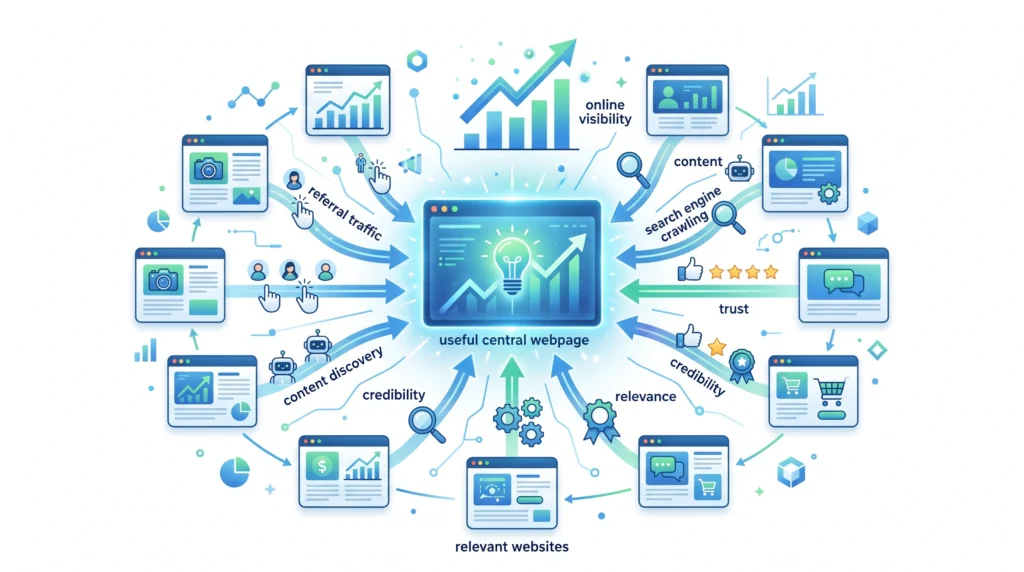
Link building can provide value in several ways.
1. It Can Help Users Discover Your Website
A relevant backlink can send visitors directly to your website.
For example, someone reading an article about SEO may click a link to your beginner’s guide.
This is known as referral traffic.
2. It Helps Connect Content Across the Web
The web is built around links.
Links help users move between related resources and help create connections between different webpages.
3. It Can Build Online Recognition
When relevant websites consistently reference your content, more people may become aware of your brand, research, expertise, or resources.
It Can Support SEO
Relevant and high-quality backlinks can be useful SEO signals.
However, link building alone does not guarantee rankings.
SEO performance also depends on factors such as:
- Content quality
- Search intent
- Technical SEO
- On-page optimization
- Competition
- Website accessibility
- Overall user value
Link building works best as part of a complete SEO strategy.
Link Building vs Backlinks
These two terms are closely related, but they are not exactly the same.
| Backlinks | Link Building |
|---|---|
| A link pointing to your website | The process of earning links |
| The result | The strategy or activity |
| Created by another website | Focused on attracting or earning links |
| Can occur naturally | May involve content, outreach, PR, and relationships |
In simple terms:
Backlink = The link
Link Building = The process of earning the link
For a complete explanation of backlinks, link to:
What Are Backlinks?backlinks
What Makes a Link Worth Building?
Not every backlink opportunity is worth pursuing.
A valuable backlink often has several characteristics.
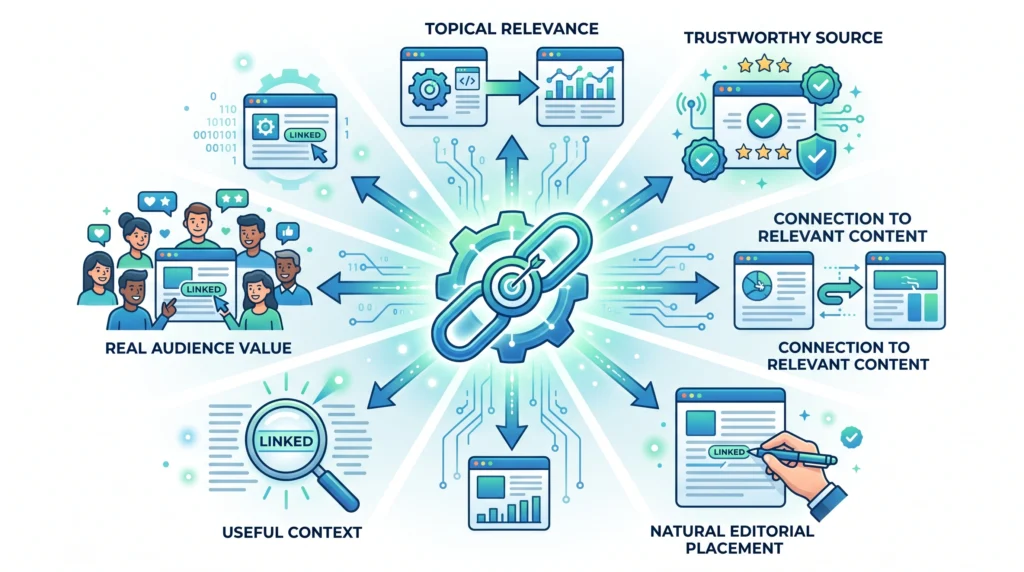
Relevance
The linking website should have a meaningful connection to your topic.
For example, if you publish an SEO guide, a link from a digital marketing website may be more relevant than a link from an unrelated website.
Quality
The website should appear legitimate and provide useful information to real users.
Avoid judging a website using only a single SEO metric.
Instead, look at the overall quality.
Ask:
- Does the website have useful content?
- Does it serve a real audience?
- Is it relevant to your industry?
- Does it appear trustworthy?
Context
A backlink should make sense within the surrounding content.
A natural link usually exists because it provides additional information or value to the reader.
User Value
A strong backlink may send relevant visitors to your website.
Ask:
Would a real person benefit from clicking this link?
If the answer is yes, it may be a more meaningful opportunity.
The Best Link Building Strategies for Beginners
There are many link-building strategies, but beginners should focus on methods that are useful, ethical, and sustainable.
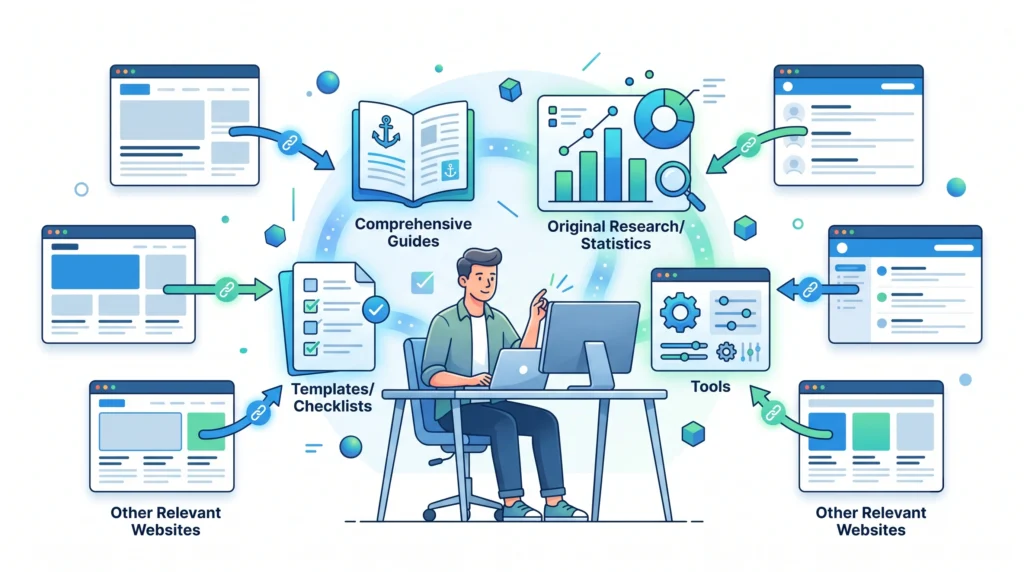
1. Create Link-Worthy Content
The best link-building campaigns often begin with useful content.
Create resources that people may genuinely want to reference.
Examples include:
- Complete guides
- Original research
- Industry statistics
- Checklists
- Templates
- Case studies
- Free tools
- Useful data
- Expert resources
Before promoting your content, ask:
“Is this page genuinely worth linking to?”
If not, improve the content first.
2. Create Original Research
Original data can provide a strong reason for other websites to link to you.
Examples include:
- Surveys
- Industry studies
- Data analysis
- Experiments
- Reports
- Original statistics
If writers, journalists, or bloggers use your data, they may reference the original source.
For example:
You publish a survey about how businesses use AI.
A marketing publication writes about the results and links to your research.
That creates a relevant editorial backlink.
3. Digital PR
Digital PR focuses on creating stories, research, or campaigns that may attract attention from publications and journalists.
Examples include:
- Original research
- Interesting industry data
- Expert opinions
- Newsworthy campaigns
- Trend analysis
The goal is not simply to send thousands of emails asking for links.
The goal is to create something worth discussing.
4. Resource Page Link Building
Some websites maintain pages containing useful resources.
For example:
- SEO resources
- Marketing tools
- Beginner guides
- Educational websites
- Industry directories
If your content genuinely improves the resource page, it may be appropriate to suggest it.
The key word is relevant.
Do not submit your website to every directory or resource page you can find.
5. Broken Link Building
Broken link building involves identifying a link on another website that no longer works.
If you have created a genuinely relevant replacement, you can contact the website owner.
For example:
- You find a broken link to an old SEO guide.
- You have a high-quality guide covering the same topic.
- You politely inform the website owner about the broken link.
- You suggest your guide as a possible replacement.
This approach can help the website owner fix a problem while potentially creating a relevant backlink opportunity.
6. Build Industry Relationships
Strong professional relationships can naturally create opportunities for:
- Collaborations
- Interviews
- Expert contributions
- Podcast appearances
- Industry discussions
- Content partnerships
Do not treat every relationship as a link transaction.
Focus on creating genuine professional connections.
Links may become a natural result of useful collaboration.
7. Guest Contributions
Writing useful content for another relevant website may provide opportunities for brand exposure and appropriate links.
However, avoid producing low-quality guest posts simply to create backlinks.
The content should provide genuine value to the host website’s audience.
8. Expert Contributions
Share useful expertise with relevant publications, websites, and industry discussions.
You may contribute:
- Expert insights
- Original opinions
- Research
- Quotes
- Educational content
If your contribution adds value, the source may mention or link to your website.
How to Build Links Step by Step

A beginner-friendly link-building process can look like this.
Step 1: Identify Your Best Pages
Choose pages that are genuinely useful and deserve attention.
Examples:
- Comprehensive guides
- Original research
- Free tools
- Important product pages
- Valuable resources
Do not try to build links to every page immediately.
Start with your strongest assets.
Step 2: Research Relevant Websites
Look for websites that:
- Cover similar topics
- Serve a similar audience
- Publish related content
- Have legitimate resources
- Could genuinely benefit from your content
Relevance should come before volume.
Step 3: Find a Genuine Reason to Contact Them
Do not simply write:
“Please link to my website.”
Instead, identify a real reason why your resource may be useful.
For example:
- Their article discusses a topic your guide explains in detail.
- Their page contains an outdated resource.
- Their audience could benefit from your original research.
- You have data relevant to their article.
Step 4: Create Personalized Outreach
Keep your message short and relevant.
Explain:
- Who you are
- Why you are contacting them
- What makes your resource relevant
- How it may help their audience
Avoid mass-produced messages that feel automated.
Step 5: Build Long-Term Relationships
Do not stop interacting after one email.
Useful relationships can lead to future opportunities.
Step 6: Monitor Your Results
Track:
- New backlinks
- Referring websites
- Referral traffic
- Successful content types
- Outreach responses
Look for patterns.
If certain types of content consistently earn links, create more resources using similar principles.
How to Do Link Building Outreach
Outreach should focus on relevance and usefulness.
A basic structure could look like this:
1. Start With Context
Mention something specific about the person’s website or content.
2. Explain Why You Are Reaching Out
Clearly explain the connection.
3. Introduce Your Resource
Briefly explain what the resource offers.
4. Explain the Value
Why might their audience benefit?
5. Keep It Simple
Avoid long emails.
The goal is to make the request easy to understand.
Remember:
Personalized and relevant outreach is generally better than sending thousands of identical messages.
Link Building Methods to Avoid
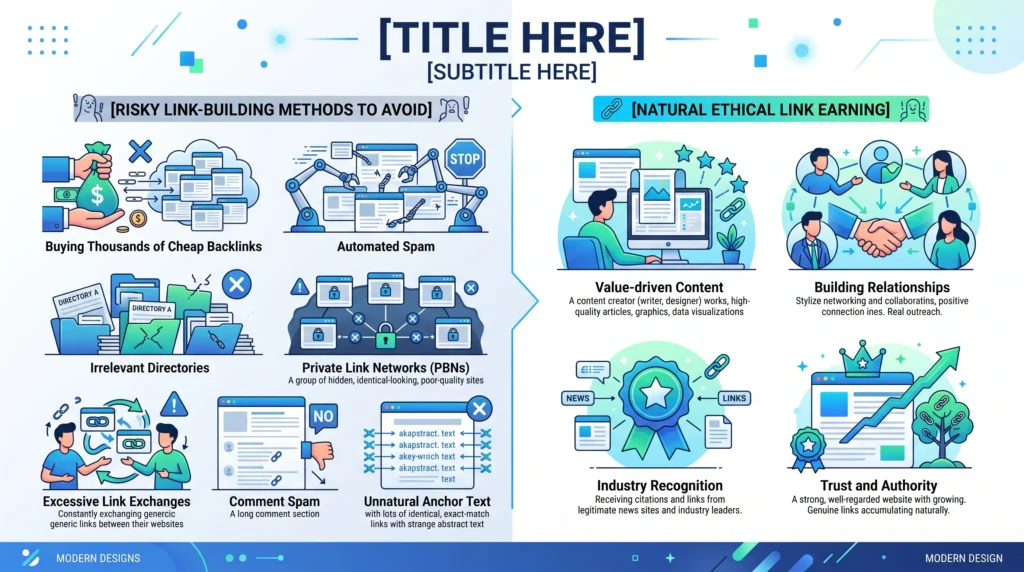
Some link-building methods focus primarily on manipulating search signals rather than providing value.
Examples include:
Buying Large Numbers of Cheap Links
Packages promising thousands of backlinks quickly may create low-quality or artificial links.
Automated Link Building
Automatically creating links across large numbers of websites can produce spammy patterns.
Comment Spam
Leaving irrelevant comments simply to create backlinks provides little value.
Irrelevant Directories
Submitting your website to hundreds of unrelated directories is rarely a sustainable strategy.
Excessive Link Exchanges
Occasional relevant collaboration is different from creating large-scale artificial link exchange networks.
Manipulative Anchor Text
Trying to force the exact same keyword into every backlink can create an unnatural pattern.
How to Measure Link Building Success
Link building success should not be measured only by the number of links acquired.
Consider multiple factors.
Number of Relevant Referring Domains
How many relevant websites are linking to your content?
Quality of Referring Websites
Are the websites legitimate and useful?
Referral Traffic
Are visitors actually clicking the links?
Brand Mentions
Is your brand being discussed more frequently across relevant websites?
Organic Performance
Over time, monitor whether your overall SEO visibility is improving.
Remember:
A backlink campaign does not guarantee rankings.
SEO results depend on multiple factors.
Common Link Building Mistakes
Focusing Only on Quantity
One relevant and valuable backlink can be more useful than many low-quality links.
Ignoring Content Quality
Weak content is difficult to promote.
Improve the resource before investing heavily in outreach.
Targeting Irrelevant Websites
A backlink should make sense for the website and its audience.
Sending Generic Outreach
Mass emails often receive poor responses.
Personalization can improve relevance.
Expecting Immediate Results
Link building is usually a long-term process.
Building relationships and earning editorial references can take time.
Chasing Every SEO Metric
Third-party metrics can provide additional data, but they should not be the only reason to pursue a backlink.
Always consider:
- Relevance
- Quality
- Audience
- Context
- User value
Beginner Link Building Checklist
Content
- Create genuinely useful content
- Identify your strongest link-worthy pages
- Improve weak content before promoting it
- Add original information where possible
Research
- Identify relevant websites
- Study their audience
- Find content related to your topic
- Look for genuine opportunities
Outreach
- Personalize your messages
- Explain why your resource is relevant
- Keep messages concise
- Avoid mass spam
- Focus on value
Link Quality
- Prioritize relevance
- Consider website quality
- Check contextual placement
- Consider referral traffic potential
- Avoid manipulative schemes
Long-Term Growth
- Build industry relationships
- Create new link-worthy resources
- Monitor backlinks
- Analyze successful content
- Improve your strategy over time
Frequently Asked Questions
What Is Link Building in Simple Words?
Link building is the process of earning backlinks from other websites to your own website.
Is Link Building Important for SEO?
Relevant and high-quality backlinks can support SEO, but link building is only one part of a complete SEO strategy.
How Can Beginners Start Link Building?
Start by creating valuable content, identifying relevant websites, building relationships, and promoting resources that genuinely help the target audience.
How Many Backlinks Do I Need?
There is no fixed number. The right approach depends on your industry, competition, content quality, and existing online presence.
Is Buying Backlinks Safe?
Buying large quantities of backlinks or participating in manipulative link schemes can create unnecessary risks. Earning relevant and editorial links is generally more sustainable.
What Is the Best Link Building Strategy?
There is no single best strategy for every website. However, creating valuable content and earning relevant editorial references is a strong long-term foundation.
How Long Does Link Building Take?
The timeline varies. Earning high-quality links, building relationships, and developing content recognition can take weeks or months.
Final Thoughts
Link building is not simply about asking websites for backlinks.
A sustainable strategy starts with value.
The process looks like this:
Create Something Useful
↓
Identify the Right Audience
↓
Find Relevant Opportunities
↓
Build Genuine Relationships
↓
Promote Your Best Resources
↓
Earn Natural Backlinks
↓
Repeat and Improve
The best link-building strategy is usually built around one simple principle:
Give people a genuine reason to reference your website.
Focus on relevance instead of quantity.
Focus on quality instead of shortcuts.
And focus on long-term relationships instead of “Dear Sir, I have an amazing opportunity for you…” emails. Those emails have suffered enough. 😄
Related Articles
Pillar 5 — Off-Page SEO & Link Building
What Is Off-Page SEO?what-is-off-page-seo
Previous Article:
What Are Backlinks?backlinks
Related Article:
Anchor Text: Complete Guideanchor-text
Related Article:
What Is SEO?what-is-seo
Related Article:
What Is On-Page SEO?what-is-on-page-seo
Internal Linking Suggestions
Naturally link this article to:
- What Is Off-Page SEO?
- What Are Backlinks?
- Anchor Text: Complete Guide
- What Is SEO?
- What Is On-Page SEO?
- Internal Linking: Complete SEO Guide
Recommended anchor text:
- link building
- how to build backlinks
- high-quality backlinks
- natural link building
- off-page SEO
- anchor text
- SEO strategy
- relevant backlinks
Also link this article back to the main Pillar 5 — Off-Page SEO & Link Building page.
Publishing Checklist
- H1 clearly labelled
- H2 headings clearly labelled
- H3 headings clearly labelled
- SEO title prepared
- Meta title prepared
- Meta description prepared
- URL slug prepared
- Focus keyword included naturally
- Secondary keywords used naturally
- Positive words included naturally
- Caution words included naturally
- Link building clearly defined
- Difference between backlinks and link building explained
- Importance of link building explained
- Valuable backlink characteristics included
- Beginner-friendly strategies included
- Link-worthy content explained
- Original research strategy included
- Digital PR included
- Resource page link building included
- Broken link building included
- Industry relationships included
- Guest contributions included
- Expert contributions included
- Step-by-step process included
- Outreach guidance included
- Risky link-building methods explained
- Success metrics included
- Common mistakes included
- Beginner checklist included
- FAQs included
- Image placements marked
- Image prompts included
- Image filenames included
- Alt text included
- Internal linking suggestions included
- No keyword stuffing
- No guaranteed ranking claims
- No guaranteed backlink claims
- Beginner-friendly language used
- Content is easy to scan
- Content provides genuine value
