
Off-page SEO refers to SEO activities that happen outside your own website and can help improve its visibility, credibility, authority, and overall presence online.
While on-page SEO focuses on improving elements within your website—such as content, headings, internal links, and metadata—off-page SEO focuses more on how your website is connected to and perceived across the wider web.
One of the most well-known parts of off-page SEO is link building. However, off-page SEO is broader than simply getting backlinks.
It can also involve:
- Earning high-quality backlinks
- Building brand awareness
- Earning relevant mentions
- Creating valuable content that people want to reference
- Digital PR
- Building credibility within your industry
- Developing a stronger online presence
In simple terms:
Off-page SEO is about building signals of trust, relevance, credibility, and recognition beyond your own website.
What Does Off-Page SEO Mean?
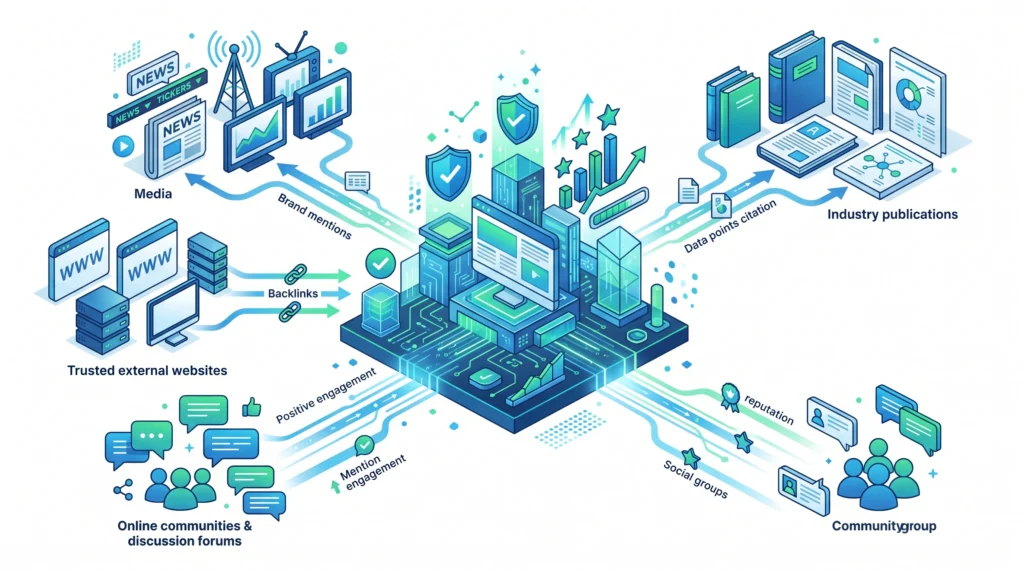
Off-page SEO includes activities and signals that happen outside the pages of your website.
For example, imagine that you publish an excellent guide about SEO.
The guide exists on your website, so creating and optimizing it is part of on-page SEO.
Now imagine that:
- An industry website links to your guide
- A blogger references your research
- A news publication mentions your brand
- Other websites recommend your content
- People search directly for your brand
These activities and signals happen beyond your website itself.
They can contribute to your broader online presence.
That is where off-page SEO becomes important.
Off-Page SEO vs On-Page SEO
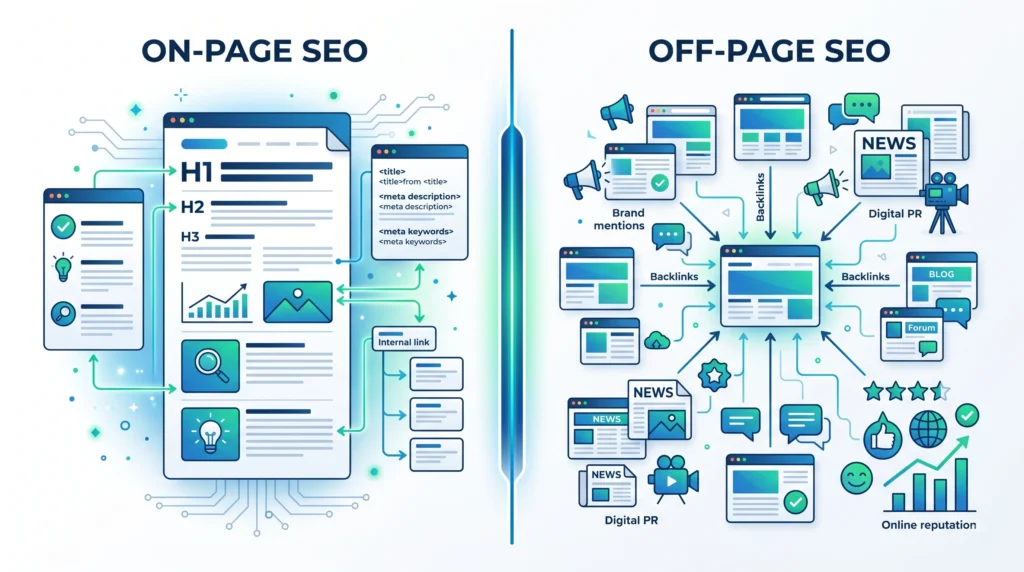
Although on-page and off-page SEO are connected, they focus on different areas.
| On-Page SEO | Off-Page SEO |
|---|---|
| Happens on your website | Happens outside your website |
| Focuses on content and page optimization | Focuses on external signals and reputation |
| Includes headings and content | Includes backlinks and brand mentions |
| Includes internal linking | Includes external links |
| You have more direct control | You often have less direct control |
A strong SEO strategy usually combines both.
For example, earning a backlink to a weak page may not create meaningful long-term results.
Similarly, publishing excellent content without building awareness or earning external references can limit its reach.
The strongest approach is usually:
Useful Content + Strong Technical Foundation + On-Page SEO + Relevant External Recognition
Why Is Off-Page SEO Important?
Off-page SEO can help search engines and users understand how a website fits into the broader web.
When other relevant and trustworthy websites reference your content, those references may provide useful signals about your website.
For example, imagine two websites publish similar guides.
One guide receives references from respected industry websites, while the other receives little external attention.
External references can help provide additional context about the popularity, usefulness, relevance, or recognition of a page or website.
However, not all links or mentions have equal value.
The quality and relevance of the source can matter significantly.
That is why off-page SEO should focus on earning relevant and credible recognition, rather than simply collecting as many links as possible.
The Main Components of Off-Page SEO
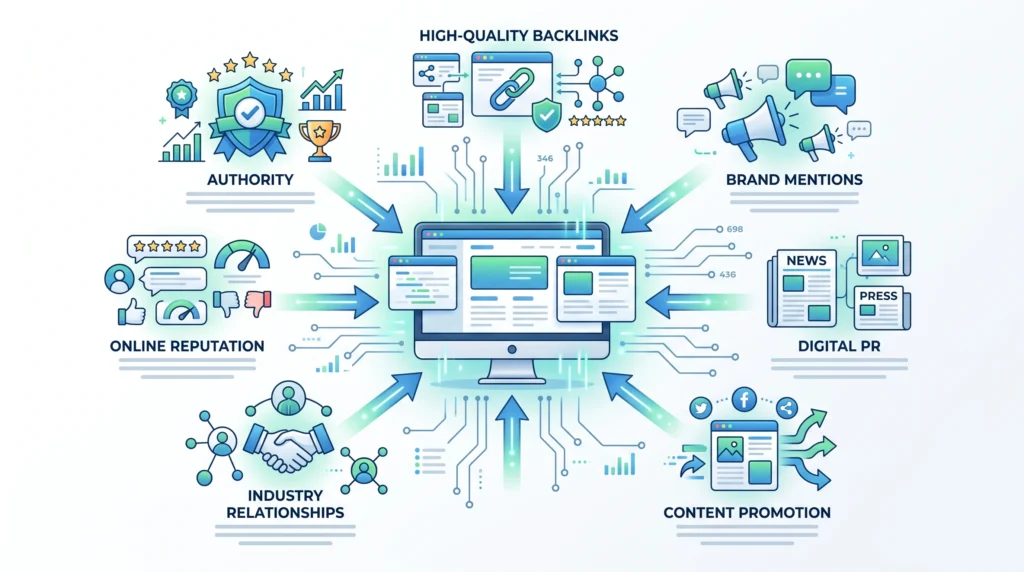
Off-page SEO includes several important areas.
1. Backlinks
Backlinks are links from one website to another.
For example:
Website A → Your Website
If another website links to one of your articles, that link is considered a backlink to your website.
Backlinks are one of the most widely discussed elements of off-page SEO.
However, the goal should not simply be to get the largest possible number of links.
A smaller number of relevant, high-quality references can be more valuable than a large number of irrelevant or low-quality links.
2. Brand Mentions
A brand mention occurs when another website, publication, or online source mentions your brand.
Not every mention includes a clickable link.
Brand recognition can still contribute to your overall online presence.
For example, if respected websites regularly discuss your company, content, research, or expertise, that can help build broader recognition.
3. Digital PR
Digital PR involves creating stories, research, resources, or campaigns that may attract attention from journalists, publications, bloggers, and industry websites.
Examples include:
- Original research
- Industry reports
- Surveys
- Expert commentary
- Unique data
- Newsworthy campaigns
The goal is to create something genuinely worth discussing or referencing.
4. Content Promotion
Publishing content does not automatically mean that people will find it.
Content promotion can help place useful resources in front of relevant audiences.
Promotion may include:
- Sharing content with relevant communities
- Reaching out to people who may find the content useful
- Building relationships with industry professionals
- Creating content that solves specific problems
The key is relevance.
Avoid promoting content aggressively to people who have no reason to care about it.
5. Online Reputation
A website or brand can develop a stronger presence through consistent, useful, and trustworthy contributions.
Online reputation may be influenced by:
- Content quality
- Brand consistency
- Industry recognition
- Customer experiences
- Public discussions
- Media coverage
Building a strong reputation is generally a long-term process.
What Are Backlinks?
Backlinks are hyperlinks from another website that point to your website.
For example:
industrywebsite.com → yourwebsite.com/seo-guide/
A backlink can help users discover your content.
Depending on the context and source, it may also provide search engines with information about the relationship between webpages.
However, backlinks should be evaluated based on more than quantity.
A useful backlink may be:
- Relevant to your topic
- Placed naturally within useful content
- Located on a credible website
- Helpful for actual readers
- Editorially earned
A backlink from a highly relevant resource may be more useful than many unrelated links.
What Makes a Good Backlink?
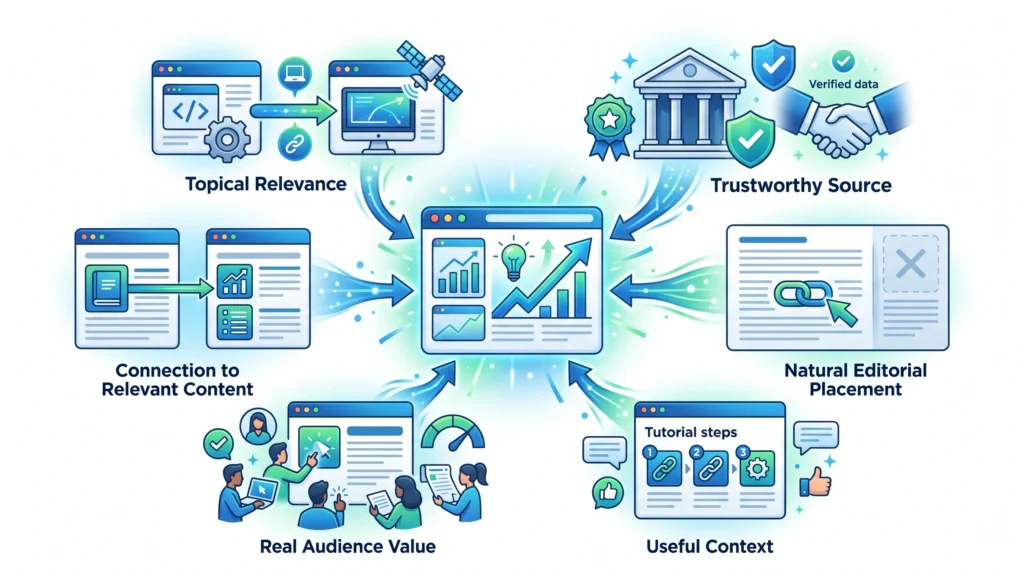
There is no single formula that makes every backlink valuable.
However, strong links often share certain characteristics.
Relevance
The linking website or page should have a meaningful connection to your topic.
For example, a backlink from a marketing publication to an SEO guide may be more contextually relevant than a link from an unrelated website.
Credibility
Links from established and trustworthy sources can be valuable signals.
However, website popularity alone should not be the only factor you consider.
Always evaluate the overall quality and relevance of the linking source.
Natural Placement
A useful link should make sense within the content.
The reader should understand why the linked resource is being recommended.
Editorial Value
The strongest links are often earned because someone genuinely believes your content is useful enough to reference.
Real User Value
A good backlink can potentially send relevant visitors to your website.
If a link would never be useful to a human reader, its SEO value should be questioned as well.
Types of Backlinks
Backlinks can appear in different forms.
Editorial Backlinks
These are naturally placed references created by editors, writers, or website owners because they consider the linked resource useful.
These are generally the type of links businesses and publishers aim to earn.
Resource Page Links
Some websites maintain collections of useful resources on a particular topic.
If your content provides genuine value, it may be relevant for inclusion.
Guest Content Links
Guest contributions can sometimes provide an opportunity to earn relevant links.
However, guest content should focus on providing useful information rather than producing large numbers of artificial links.
Digital PR Links
News stories, research reports, and media coverage may create opportunities for natural editorial references.
Business and Industry Mentions
Businesses may earn links through partnerships, professional organizations, relevant directories, or industry resources.
The key factor is whether the listing or mention provides genuine value and relevance.
What Is Link Building?
Link building is the process of earning or acquiring relevant backlinks to your website.
A sustainable link-building strategy focuses on creating genuine reasons for other people to reference your content.
Instead of asking:
“How can I get as many links as possible?”
Ask:
“Why would someone genuinely want to link to this page?”
That question often leads to a better strategy.
Useful reasons may include:
- Original research
- Helpful guides
- Unique data
- Free tools
- Expert insights
- Strong visual resources
- Useful templates
- Comprehensive educational content
The best link-building strategies usually begin with something worth linking to.
Popular Link-Building Strategies
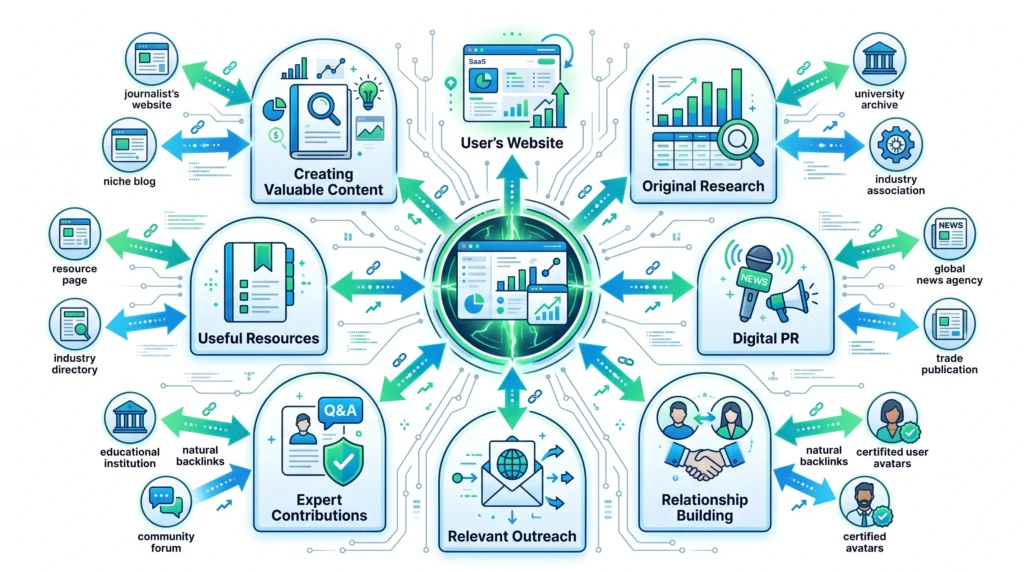
Here are several commonly used approaches.
Create Link-Worthy Content
Create resources that provide enough value to deserve references.
Examples include:
- Comprehensive guides
- Original research
- Statistics
- Case studies
- Free tools
- Templates
- Checklists
Digital PR
Create interesting stories or research that relevant publications may want to cover.
Resource Link Building
Identify relevant resource pages where your content provides genuine value.
Broken Link Opportunities
Sometimes websites contain broken links to resources that no longer exist.
If you have created a genuinely useful and relevant alternative, you may inform the website owner.
The focus should be on helping improve the resource, not sending large volumes of automated requests.
Relationship Building
Building genuine professional relationships can naturally lead to collaboration, mentions, and references.
What Is Bad Link Building?
Not every link-building method is sustainable.
Some practices attempt to artificially manipulate search engine signals rather than earn genuine references.
Examples may include:
- Buying large numbers of low-quality links
- Automated link creation
- Spam comments
- Irrelevant directory submissions
- Private link networks created primarily for manipulation
- Excessive link exchanges
- Artificial anchor text manipulation
These practices can create unnecessary risk.
The safest long-term strategy is to focus on earning links because your content, business, product, research, or expertise genuinely deserves attention.
Off-Page SEO Beyond Backlinks
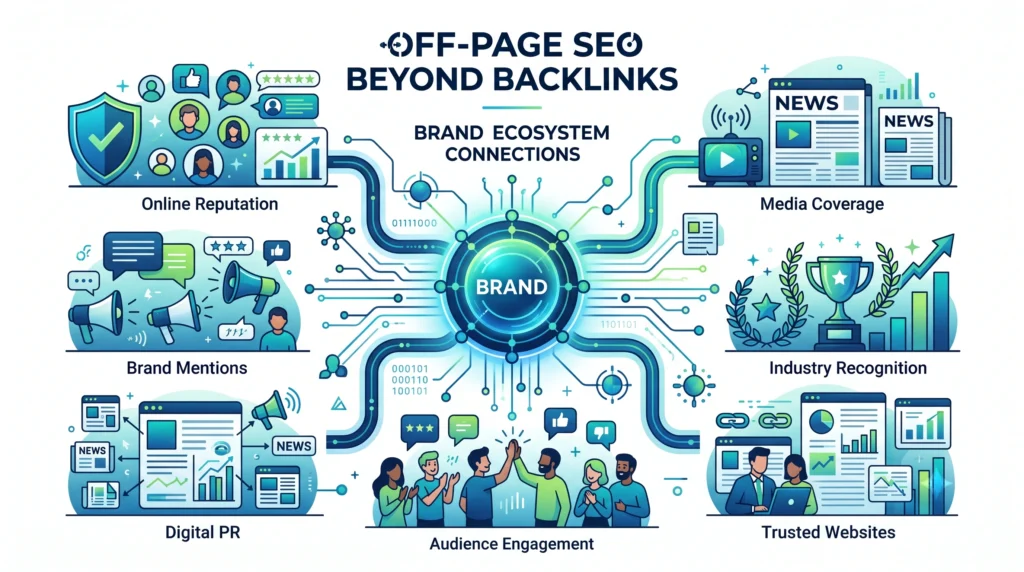
Backlinks are important, but they are not the entire off-page SEO strategy.
A strong online presence can also involve:
Brand Awareness
People becoming familiar with your brand.
Industry Recognition
Being recognized as a useful source within your niche.
Expert Contributions
Sharing useful knowledge through relevant platforms and publications.
Public Relations
Earning legitimate media attention.
Community Participation
Contributing useful information where relevant audiences are already active.
The focus should always remain on providing value.
How to Build an Off-Page SEO Strategy
A beginner-friendly strategy can follow these steps.
Step 1: Create Valuable Content
Before building links, make sure you have something useful to promote.
Ask:
- Is the content genuinely helpful?
- Does it solve a real problem?
- Is it better, clearer, or more useful than existing alternatives?
- Would someone naturally want to reference it?
Step 2: Identify Relevant Websites and Audiences
Focus on websites and communities connected to your industry.
Relevance is often more important than simply targeting the largest websites.
Step 3: Build Genuine Relationships
Connect with people, organizations, and professionals where there is a genuine reason to interact.
Avoid treating every relationship as a link opportunity.
Step 4: Promote Useful Resources
Share your best content with people who may genuinely benefit from it.
Keep outreach relevant and personalized.
Step 5: Earn Recognition Over Time
Sustainable off-page SEO usually requires patience.
Focus on consistently creating useful work and building a credible online presence.
How Long Does Off-Page SEO Take?
Off-page SEO is generally a long-term process.
Building relationships, earning recognition, and attracting high-quality backlinks can take time.
The timeline can depend on:
- Your industry
- Competition
- Content quality
- Existing brand awareness
- Website history
- Available resources
- Promotion strategy
Be cautious of anyone promising immediate authority or guaranteed rankings through backlinks.
A sustainable strategy usually focuses on steady, relevant growth.
Common Off-Page SEO Mistakes
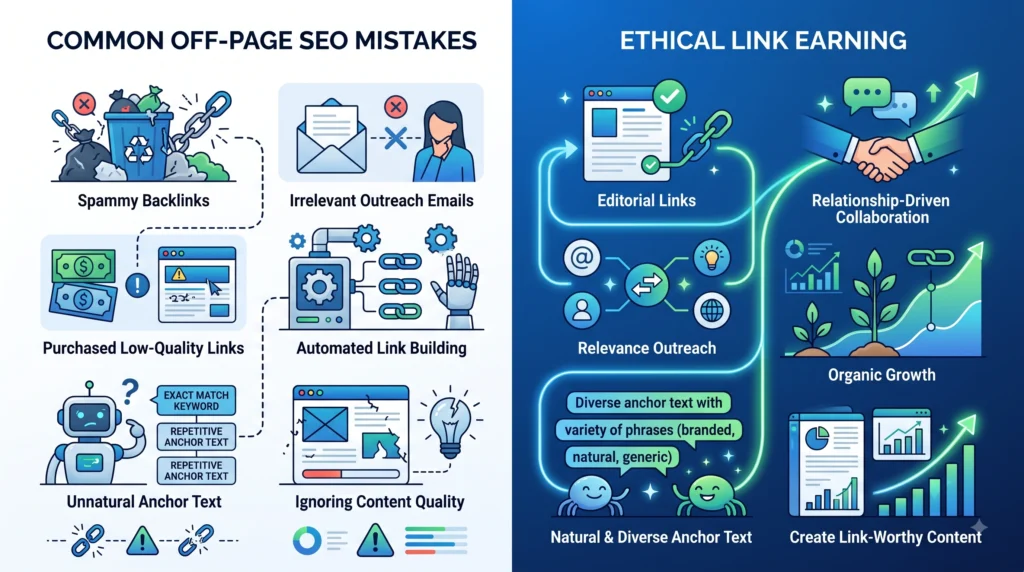
Focusing Only on Link Quantity
More links do not automatically mean better SEO.
Quality and relevance matter.
Buying Spammy Links
Artificial link schemes can create unnecessary risk.
Ignoring Content Quality
It is difficult to earn strong editorial links to weak content.
Sending Irrelevant Outreach
Contacting people who have no connection to your content wastes time and damages relationships.
Using Manipulative Anchor Text
Forcing the same keyword repeatedly into backlinks can appear unnatural.
Ignoring Brand Building
A strong brand can create opportunities for mentions, searches, relationships, and recognition.
Off-Page SEO Checklist
Content Foundation
- Important pages provide genuine value
- Content is accurate and useful
- Link-worthy resources have been identified
- Important pages are technically accessible
Link Building
- Relevant websites are prioritized
- Link opportunities provide real value
- Outreach is personalized and useful
- Artificial link schemes are avoided
- Link quality is prioritized over quantity
Brand Building
- Brand messaging is consistent
- Industry relationships are being developed
- Useful expertise is shared publicly where relevant
- Digital PR opportunities are considered
Monitoring
- New backlinks are reviewed
- Suspicious patterns are investigated
- Competitor activity is studied carefully
- Long-term growth is measured
Frequently Asked Questions
What Is Off-Page SEO in Simple Words?
Off-page SEO refers to activities and signals outside your website that can support its credibility, visibility, reputation, and authority.
Is Link Building Part of Off-Page SEO?
Yes. Link building is one of the best-known components of off-page SEO, but off-page SEO also includes brand mentions, digital PR, reputation building, and other forms of online recognition.
Are Backlinks Still Important?
Relevant, high-quality backlinks can still be useful signals. However, SEO success depends on many factors, including content quality, relevance, technical accessibility, and user value.
How Many Backlinks Do I Need?
There is no universal number. The goal should be to earn relevant and valuable links rather than simply reaching a specific quantity.
Can I Buy Backlinks?
Buying large numbers of links or participating in manipulative link schemes can create risks. A safer long-term approach is to earn relevant editorial references.
Is Off-Page SEO Only About Backlinks?
No. It can also involve brand awareness, digital PR, industry recognition, relevant mentions, and online reputation.
How Long Does Off-Page SEO Take?
Results can vary depending on competition, content, existing reputation, industry, and the quality of your strategy. Off-page SEO is generally a long-term process.
Final Thoughts
Off-page SEO is about more than trying to collect backlinks.
A strong strategy focuses on building a website and brand that other people genuinely want to:
Reference
↓
Recommend
↓
Discuss
↓
Link to
↓
Trust
The foundation of sustainable off-page SEO is simple:
Create something valuable.
Then make the right people aware that it exists.
Over time, useful content, genuine relationships, industry recognition, digital PR, and relevant backlinks can help strengthen your website’s broader online presence.
Instead of chasing shortcuts, focus on building something worth talking about.
That approach is generally more sustainable—and much less likely to turn your SEO strategy into a small dumpster fire. 🔥
Related Articles
Pillar 1 — SEO Basics
What Is SEO?what-is-seo
Pillar 3 — On-Page SEO
What Is On-Page SEO?what-is-on-page-seo
Pillar 3 — On-Page SEO
Internal Linking: Complete SEO Guideinternal-linking
Pillar 4 — Technical SEO
What Is Technical SEO?what-is-technical-seo
Next Article:
Link Building: Complete Beginner’s Guidelink-building
Internal Linking Suggestions
Naturally link this article to:
- What Is SEO?
- What Is On-Page SEO?
- Internal Linking: Complete SEO Guide
- What Is Technical SEO?
- Link Building: Complete Beginner’s Guide
- Backlinks: Complete Guide
- Anchor Text: Complete Guide
Recommended anchor text:
- off-page SEO
- link building
- high-quality backlinks
- on-page SEO
- technical SEO
- internal linking
- website authority
- brand mentions
Also link this article back to the main Pillar 5 — Off-Page SEO & Link Building page.
Publishing Checklist
- H1 clearly labelled
- H2 headings clearly labelled
- H3 headings clearly labelled
- SEO title prepared
- Meta title prepared
- Meta description prepared
- URL slug prepared
- Focus keyword included naturally
- Secondary keywords used naturally
- Positive words included naturally
- Caution words included naturally
- Off-page SEO clearly defined
- Off-page vs on-page SEO comparison included
- Importance of off-page SEO explained
- Backlinks explained
- Good backlink characteristics included
- Types of backlinks explained
- Link building explained
- Link-building strategies included
- Risky link-building practices explained
- Brand mentions included
- Digital PR included
- Online reputation included
- Step-by-step off-page SEO strategy included
- Common mistakes included
- Checklist included
- FAQs included
- Image placements marked
- Image prompts included
- Image filenames included
- Alt text included
- Internal linking suggestions included
- No keyword stuffing
- No guaranteed ranking claims
- No guaranteed backlink claims
- Beginner-friendly language used
- Content is easy to scan
- Content provides genuine value
