

What Are Long-Tail Keywords?
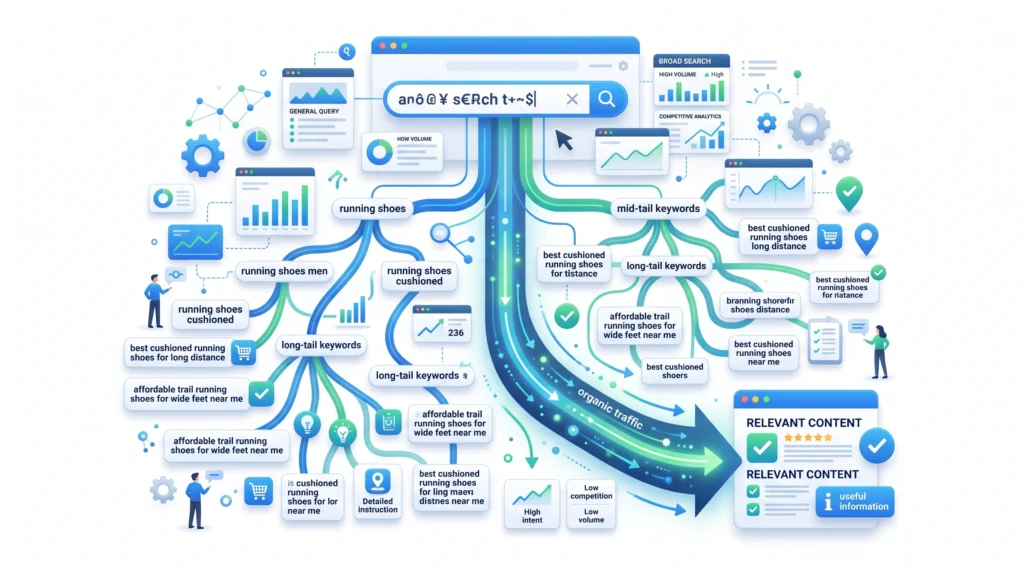
Long-tail keywords are specific search phrases that usually contain multiple words and describe a more focused search need.
For example:
Short-tail keyword:
SEO
More specific keyword:
SEO for small businesses
Long-tail keyword:
How to do SEO for a small business website
The longer phrase gives you more information about what the searcher wants.
Long-tail keywords aren’t necessarily defined only by the number of words they contain. The more important factor is their specificity and intent.
They often represent a particular question, problem, product need, or situation.
Why Are Long-Tail Keywords Important for SEO?
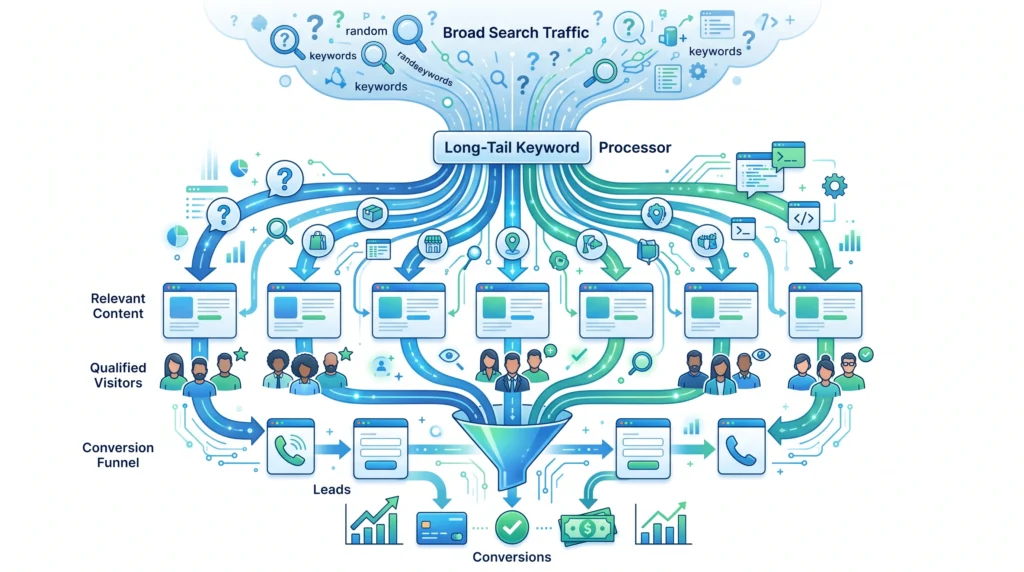
Long-tail keywords can be valuable because they often provide more context about what a person wants.
For example:
“Shoes”
is extremely broad.
But:
“Best running shoes for beginners with flat feet”
is much more specific.
A specific query can help you understand:
- What the person needs
- What problem they have
- What information they want
- What product they may be considering
- What type of content could satisfy them
Long-tail keywords can therefore help you create more focused and relevant content.
Long-Tail Keywords vs Short-Tail Keywords
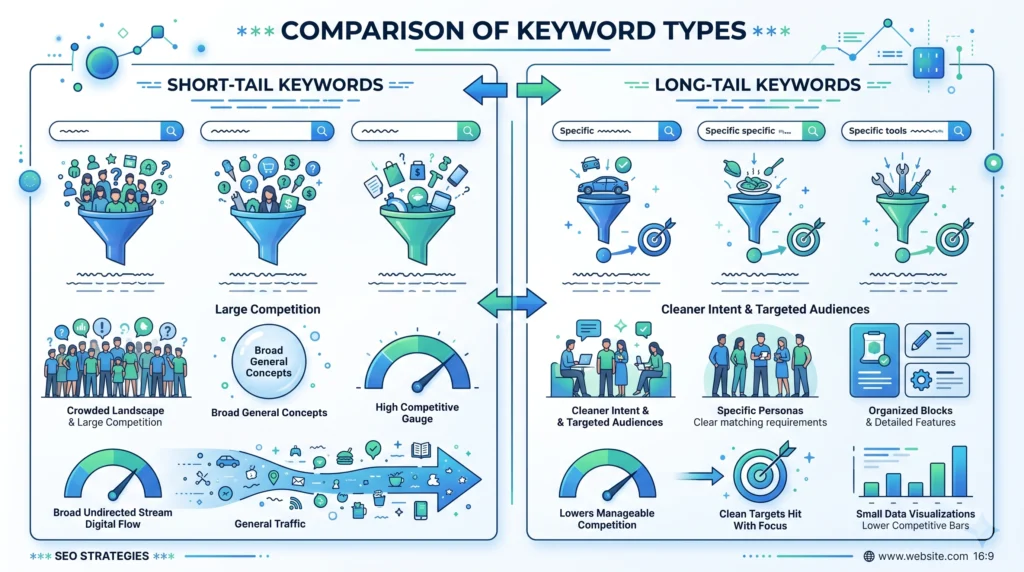
The main difference is breadth versus specificity.
| Short-Tail Keywords | Long-Tail Keywords |
|---|---|
| Broad | Specific |
| Usually shorter | Usually longer |
| Wider audience | More focused audience |
| Often highly competitive | Competition varies |
| Less context | More context |
| Broad intent | Often clearer intent |
Example
Short-tail:
Keyword research
Long-tail:
How to do keyword research for a new website
The second query tells you much more about the user’s situation.
Are Long-Tail Keywords Always Long?
Not necessarily.
The term “long-tail” doesn’t simply mean a keyword must contain a specific number of words.
A three-word query can be very specific.
A five-word query can still be broad.
What matters is the specificity, intent, and search behavior associated with the query.
For example:
“SEO tools”
is relatively broad.
“Best free SEO tools for small business websites”
is much more specific.
So instead of counting words alone, focus on what the search query tells you about the user’s goal.
What Are Some Long-Tail Keyword Examples?
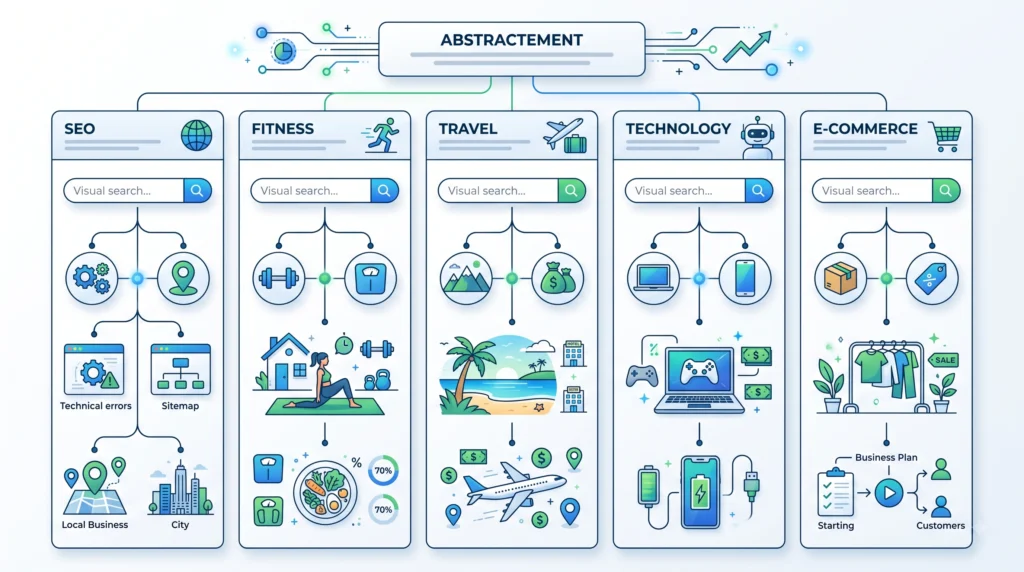
Here are some examples:
SEO
Broad:
SEO
Long-tail:
SEO tips for small business websites
Fitness
Broad:
Workout
Long-tail:
Beginner home workout without equipment
Travel
Broad:
Paris travel
Long-tail:
Best things to do in Paris for first-time visitors
E-commerce
Broad:
Running shoes
Long-tail:
Best running shoes for beginners under $100
Technology
Broad:
Laptop
Long-tail:
Best laptop for students under $800
The specific query provides more information about the searcher’s needs.
How to Find Long-Tail Keywords
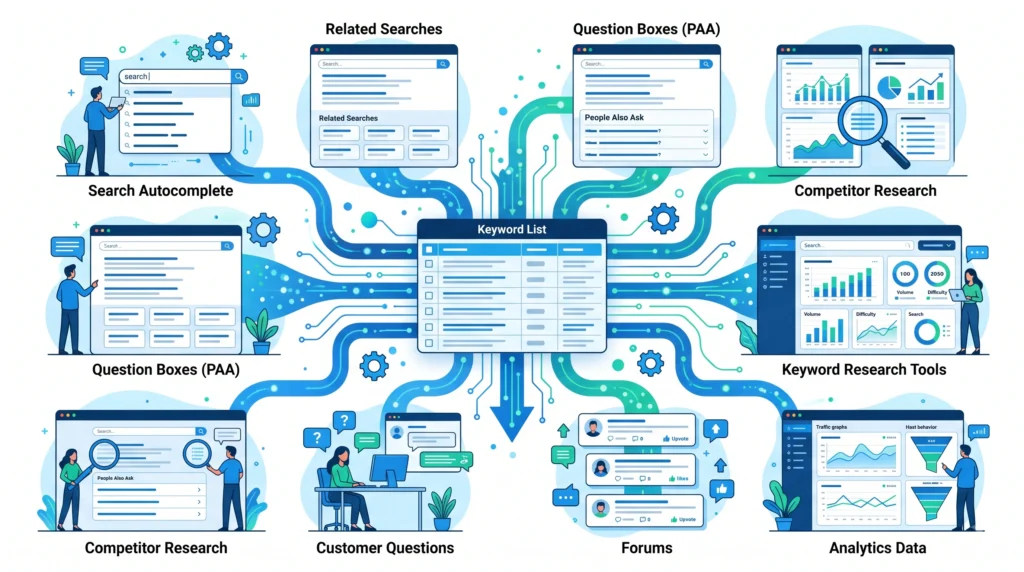
There are several effective ways to discover long-tail keyword ideas.
Use Search Suggestions
Start typing a broad topic into a search engine.
Search suggestions can reveal more specific phrases people may be searching for.
For example, starting with:
keyword research
can lead to more specific searches related to:
- beginners
- tools
- process
- strategy
- examples
- specific industries
These suggestions can become useful starting points for your research.
Check Related Searches
Related searches can reveal additional variations and connected topics.
They are particularly useful for discovering:
- Questions
- Specific problems
- Related topics
- Alternative wording
- More detailed searches
Look for Questions
Question-based searches are often excellent long-tail opportunities.
Examples:
- How do long-tail keywords work?
- How can I find long-tail keywords?
- Are long-tail keywords good for SEO?
- How many long-tail keywords should I target?
These questions can become dedicated articles, FAQ sections, or supporting sections within larger guides.
Analyze Competitor Content
Competitor pages can reveal specific topics and phrases you may not have considered.
Look for:
- Questions they answer
- Subtopics they cover
- Specific problems they address
- Page titles
- Headings
- Related content
The goal is not to copy their keywords blindly.
Instead, identify opportunities to provide better, clearer, or more useful information.
Use Keyword Research Tools
Keyword research tools can help uncover:
- Related keywords
- Search volume estimates
- Keyword difficulty
- Search trends
- Question keywords
- Keyword variations
Use the data as guidance rather than treating any single metric as an absolute answer.
Use Your Existing Search Data
If your website already receives organic impressions, your search performance data can reveal queries people are using to discover your pages.
Some of these queries may be highly specific.
These can provide ideas for:
- New articles
- Content updates
- FAQ sections
- Supporting pages
- New keyword targets
How to Choose the Right Long-Tail Keywords
Finding hundreds of long-tail keywords doesn’t mean you should target all of them.
Evaluate each opportunity using several factors.
Relevance
Does the keyword relate directly to your website or content?
Search Intent
What does the person actually want?
Specificity
Does the query communicate a clear need?
Competition
Can your website realistically compete?
Business Value
Could the query attract visitors who are useful to your business?
Content Opportunity
Can you create a genuinely helpful page around the topic?
The best keyword is not necessarily the one with the highest search volume.
It’s the one that makes sense for your audience and your goals.
Long-Tail Keywords and Search Intent
Search intent is especially important when working with long-tail keywords.
A detailed query often gives you useful clues about the user’s purpose.
For example:
“What are long-tail keywords?”
This is clearly informational.
The user wants an explanation.
But:
“Best long-tail keyword research tool”
suggests commercial investigation.
And:
“Buy keyword research software”
has transactional intent.
Understanding this difference helps you choose the correct content format.
For more information, see:
Article 7 — What Is Search Intent?
Long-Tail Keywords and Content Strategy

Long-tail keywords can be useful for building a structured content strategy.
Suppose your main topic is:
Keyword Research
You could create supporting content around:
- What is keyword research?
- How to do keyword research
- How to find long-tail keywords
- What is search intent?
- How to check keyword difficulty
- Best keyword research tools for beginners
Each specific topic can answer a particular question.
Together, these pages can form a broader topic cluster.
Should One Page Target Multiple Long-Tail Keywords?
Yes, when those keywords have closely related meanings and the same underlying search intent.
For example, these may be closely related:
- what are long-tail keywords
- long-tail keywords definition
- long-tail keywords meaning
- what is a long-tail keyword
Creating separate pages for every tiny variation may not provide additional value.
Instead, one comprehensive page can naturally cover closely related variations.
The key principle is:
One page should have one clear primary purpose.
Long-Tail Keywords and Keyword Clustering
Keyword clustering means grouping related search queries around a common topic or intent.
For example:
Main Topic
Long-Tail Keywords
Related Queries
- What are long-tail keywords?
- Long-tail keywords for beginners
- How to find long-tail keywords
- Long-tail keyword examples
- Long-tail keywords vs short-tail keywords
- Long-tail keyword strategy
These can be organized into a content plan.
Keyword clustering can help you:
- Plan content
- Identify supporting topics
- Improve internal linking
- Avoid unnecessary duplication
- Build topical coverage
Benefits of Long-Tail Keywords

Long-tail keywords can offer several potential advantages.
More Specific Targeting
They can help you target a particular audience need.
Clearer Search Intent
Specific queries often provide stronger clues about what users want.
Focused Content
They can make it easier to create content around a precise question or problem.
Niche Opportunities
Specific searches may reveal opportunities that broad keywords don’t show.
Potentially More Qualified Traffic
When the query closely matches your content, visitors may be more relevant to your topic or offer.
Remember that these are opportunities, not guarantees.
Are Long-Tail Keywords Easier to Rank For?
Sometimes, but not always.
A long-tail keyword may have lower competition than a broad keyword, but this isn’t guaranteed.
Some specific queries can still be highly competitive.
Instead of assuming:
Long-tail = Easy
think:
Long-tail = More Specific
Then evaluate:
- Competition
- Search intent
- Relevance
- Existing search results
- Website authority
- Content quality
This produces a much more realistic SEO strategy.
Long-Tail Keywords and Voice Search
People often use conversational language when speaking to search assistants.
This can create longer, question-based queries such as:
How do I find long-tail keywords for SEO?
or:
What are the best SEO tools for beginners?
Conversational searches aren’t automatically long-tail opportunities, but the overlap can be useful.
Creating content that clearly answers natural questions can help you cover these types of searches.
Common Long-Tail Keyword Mistakes
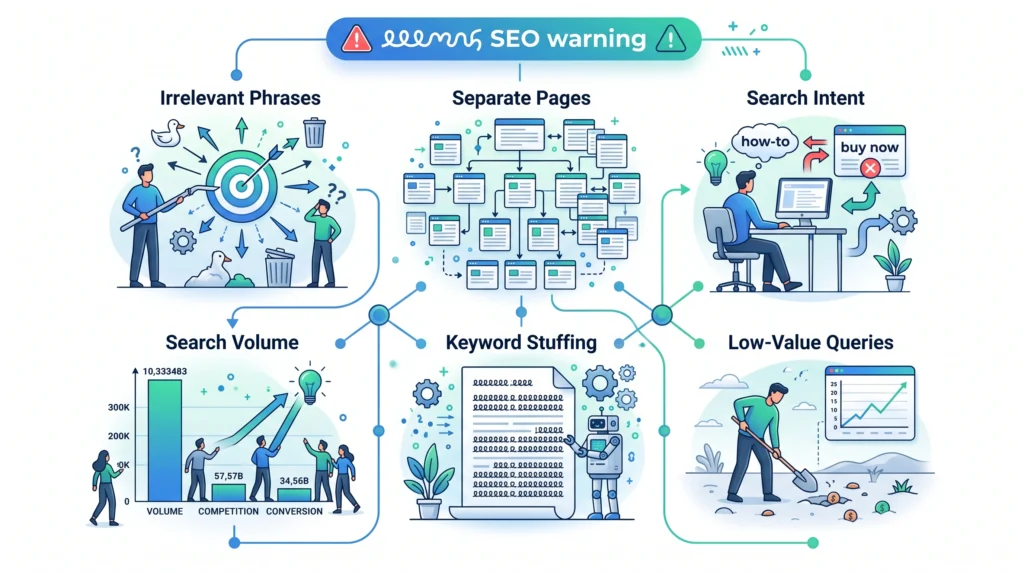
Choosing Irrelevant Keywords
A keyword isn’t valuable simply because it has low competition.
It must also be relevant.
Targeting Every Variation Separately
Very similar keyword variations may belong naturally on one comprehensive page.
Ignoring Search Intent
A specific query can still have the wrong intent for your content.
Focusing Only on Search Volume
Low-volume doesn’t automatically mean bad, and high-volume doesn’t automatically mean good.
Keyword Stuffing
Don’t repeatedly insert long-tail phrases into content unnaturally.
Writing Thin Content
A specific keyword still deserves a useful answer.
Don’t create a low-quality page just because the keyword appears easy to target.
Long-Tail Keyword Strategy for Beginners
If you’re new to SEO, follow this simple process:
Step 1: Choose a broad topic.
Step 2: Find specific search questions.
Step 3: Analyze search intent.
Step 4: Check competition and relevance.
Step 5: Group related keywords.
Step 6: Choose realistic opportunities.
Step 7: Create genuinely useful content.
Step 8: Add relevant internal links.
Step 9: Monitor performance.
Step 10: Improve the content over time.
This approach is much more effective than simply collecting a huge list of keywords.
Long-Tail Keyword Example: From Research to Content
Imagine you run a website about SEO.
Your broad keyword is:
SEO
You narrow it down:
SEO for beginners
Then:
SEO tips for beginners
Then:
SEO tips for beginners with a new website
Now the query provides much more context.
You can create an article specifically designed to help someone with a new website who is learning SEO.
This is the power of specificity.
Frequently Asked Questions
What Are Long-Tail Keywords?
Long-tail keywords are specific search phrases that usually describe a focused user need, question, or situation.
Why Are Long-Tail Keywords Important?
They can help you target specific audiences, understand search intent, discover niche content opportunities, and create more focused pages.
Are Long-Tail Keywords Better Than Short-Tail Keywords?
Neither is automatically better.
The right choice depends on your topic, audience, search intent, competition, and SEO goals.
How Do I Find Long-Tail Keywords?
You can use search suggestions, related searches, question-based searches, competitor research, keyword research tools, and your own website search data.
Do Long-Tail Keywords Have Less Search Volume?
Often they have lower individual search volume than broad keywords, but this varies. Their value can come from their specificity and relevance rather than volume alone.
Are Long-Tail Keywords Easier to Rank For?
They can sometimes have lower competition, but there is no guarantee. Competition should be evaluated for each individual keyword.
How Many Long-Tail Keywords Should I Use?
There is no fixed number.
Focus on one clear topic and naturally include closely related phrases that help answer the user’s needs.
Should Every Long-Tail Keyword Have Its Own Page?
No.
If several keywords have the same search intent, one strong page may be better than multiple thin or overlapping pages.
Can Long-Tail Keywords Increase Organic Traffic?
They can contribute to organic traffic when they are relevant, have search demand, and are supported by useful content that satisfies the searcher’s intent.
Final Thoughts
Long-tail keywords are not simply “long keywords.”
They are about specificity, relevance, and user intent.
A broad keyword might tell you the general topic.
A long-tail keyword can tell you much more about the person’s specific need.
That’s why long-tail keywords can be valuable for a focused SEO strategy.
Remember:
Broad Topic → Specific Query → Clear Intent → Useful Content → Targeted SEO Opportunity
Don’t chase every keyword variation.
Instead, find the specific searches that matter to your audience and create content that genuinely helps them.
Related Articles
Article 5:
What Is Keyword Research?what-is-keyword-research
Article 6:
How to Do Keyword Research Step by Stepkeyword-research-guide
Article 7:
What Is Search Intent?search-intent
Article 9:
Keyword Difficulty: What It Is & How to Choose the Right Keywordskeyword-difficulty
Internal Linking Suggestions
Use natural anchor text such as:
- keyword research
- how to do keyword research
- search intent
- keyword difficulty
- keyword research guide
Link this article back to the main Pillar 2 — Keyword Research page.
Also connect it naturally with Articles 5, 6, 7, and 9.
Publishing Checklist
- H1 used once
- H2 headings clearly labelled
- H3 headings clearly labelled
- Focus keyword included naturally
- SEO title prepared
- Meta title prepared
- Meta description prepared
- URL slug prepared
- Positive words included naturally
- Caution words included naturally
- Long-tail keywords clearly explained
- Short-tail vs long-tail comparison included
- Long-tail examples included
- Search intent explained
- Long-tail keyword research methods included
- Competitor research included
- Keyword clustering included
- Content strategy included
- Benefits explained
- Common mistakes included
- Beginner strategy included
- FAQs included
- Image placements marked
- Image prompts included
- Image filenames included
- Alt text included
- Internal linking planned
- No keyword stuffing
- No guaranteed ranking claims
- Content is beginner-friendly
- Content is easy to scan
- Content provides genuine value
